CNC basics
Cutting Tools: Types, Design and How to Choose the Right Ones
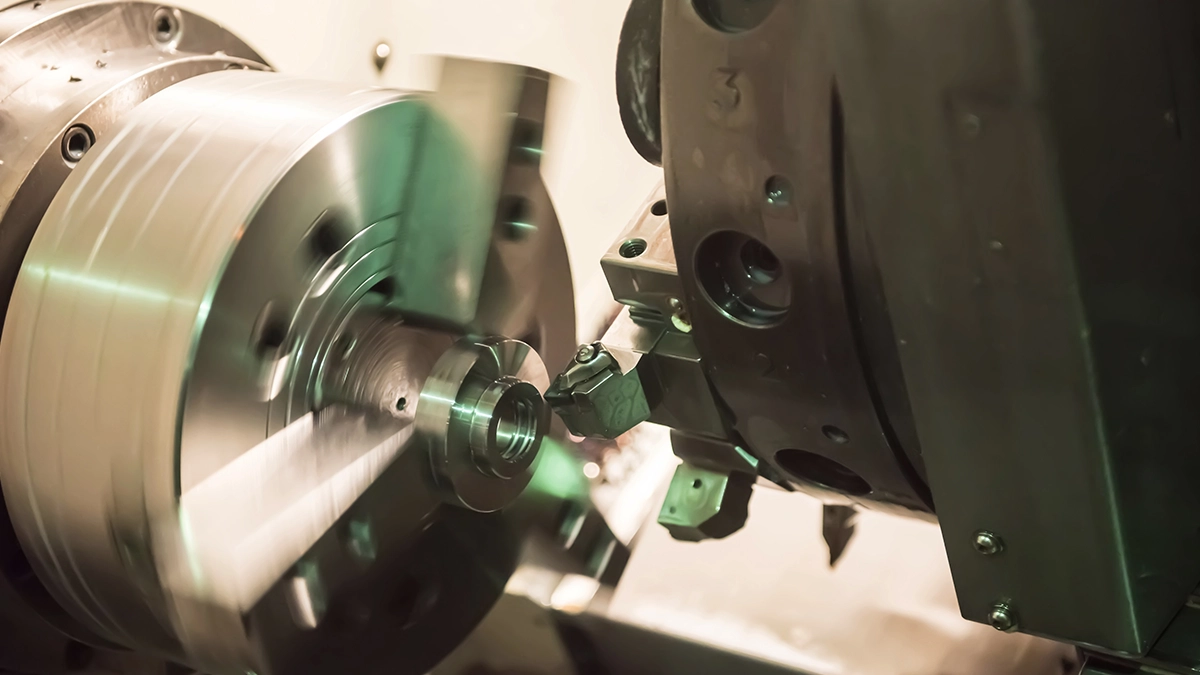
A machine tool can have the best control system and the stiffest frame, but all the real work in the material is done by cutting tools: turning tools, mills, drills and saws. In this guide we sort out the tool types, their design and the materials they are made of, and finally advise what a sensible selection of cutting tools for a specific operation looks like and what today's market has to offer.
Metal cutting and the basic cutting tools
Metal cutting consists of removing a layer of material with an edge, in the form of a chip, until the part reaches the required shape, dimension and surface roughness. Every edge, from the simplest drill to multi-edge indexable cutters, works on the same principle: a wedge forced into the material at the right speed and feed.
The differences begin with geometry, the number of edges and the mounting method, and these define the basic cutting tools used in workshops.
The simplest classification follows the operation. Turning operations are handled by turning tools, milling belongs to mills and milling heads, hole machining to drills, reamers and taps, and cutting stock to length is the job of saws. More specialised operations, such as broaching or gear hobbing, have their own dedicated tools, but the working principle stays identical. On top of this comes the distinction between single-edge tools (the turning tool) and multi-edge tools (mills, drills, saws), whose edges take turns in the cut, sharing heat and wear between them. In practice, all cutting tools in a modern workshop have one thing in common: more and more of them are indexable tools with replaceable inserts instead of permanently ground edges.
What cutting tools are made of: HSS, HSS-E and carbide
The material decides what an edge can do: high-speed steel (HSS), its cobalt variant, sintered carbide or superhard materials. The oldest group are tools made of high-speed steel (HSS): cheap, resistant to chipping and easy to regrind, but losing hardness above about 600°C, which limits cutting speed.
The HSS-E variant with added cobalt withstands higher temperatures and performs better in difficult materials, which is why HSS-E drills and taps are the standard for stainless steels. The modern workhorse, however, is sintered carbide: carbide tools run several times faster than high-speed steel and stay sharp many times longer, at the price of greater brittleness and cost. At the top are tools made of superhard materials: ceramics, CBN and polycrystalline diamond, used for cast irons, hardened steels and high-parameter aluminium machining.
The second ingredient of a modern edge are coatings: thin layers of TiN, TiAlN or AlCrN applied by PVD or CVD raise surface hardness and thermal resistance. That is why high-quality cutting tools are almost always coated, and the gold, violet or graphite colour reveals the coating type. Not every tool needs carbide and coatings, though: a good cutting tool range combines these materials so that the cost of the edge matches the operation.
Indexable tools and cutting inserts
The biggest change of recent decades are indexable tools: a body with a pocket in which replaceable carbide inserts are clamped by a screw or lever. When the edge dulls, nothing needs regrinding - you rotate the insert to the next edge or replace it with a new one, and the geometry stays perfectly repeatable.
Indexable tools dominate wherever operations must be repeatable and fast: from production lathes to large machining centres.
Multi-edge inserts
Multi-edge inserts carry several cutting edges on one piece: a triangular TNMG insert gives 6 edges (3 per side), a square SNMG up to 8. The insert designation according to ISO 1832 encodes shape, clearance angle, tolerance and chipbreaker, so an insert from one manufacturer fits another maker's pocket. As a result, indexable tooling is costed per edge rather than per piece, and this often decides the economics of the whole operation.
Turning tools
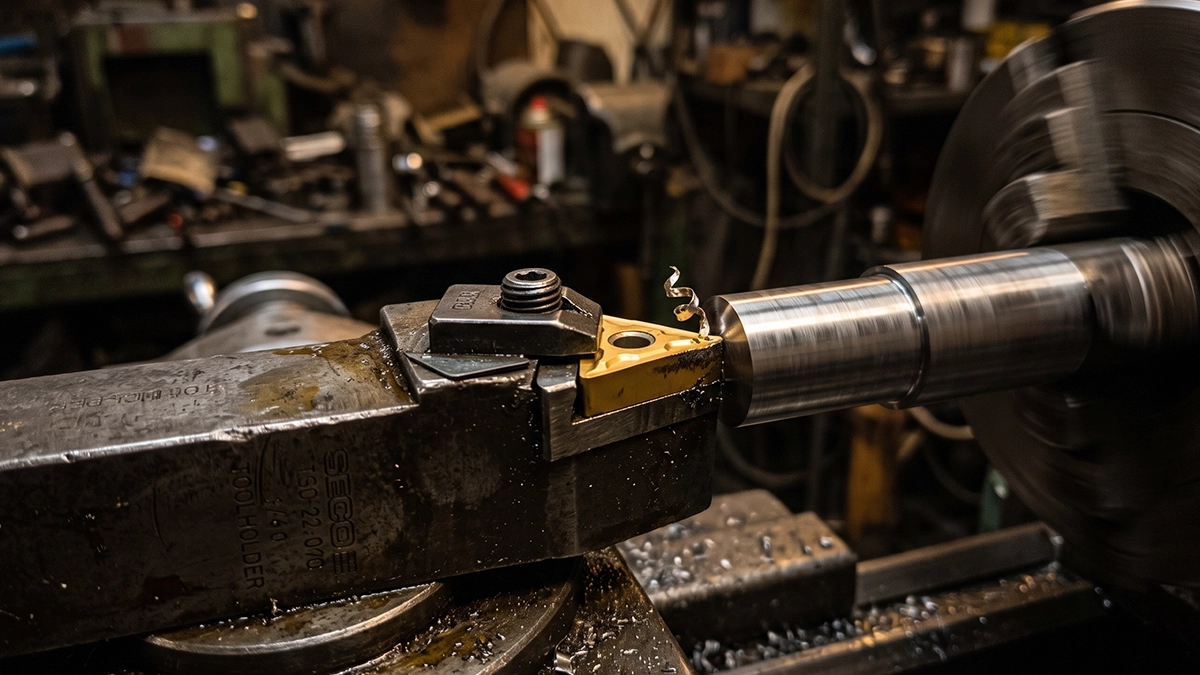
The turning tool is conceptually the simplest tool: a single edge guided along a rotating workpiece. Its design comprises the shank (the part clamped in the tool post), the working part and the edge with its rake and clearance faces; the indexable version adds the pocket and the insert.
The apparent simplicity hides a whole family of variants and its own designation system.
Types of turning tools
The basic types of turning tools are roughing tools for heavy stock removal, finishing tools for the final passes, parting tools for cutting off, boring bars for machining holes from inside, and thread and groove tools. Older national designations describe brazed-tip and solid HSS tools, still met in schools and one-off work; those designations still appear in older catalogues.
Indexable turning tools and insert-type tools
Today's standard is the indexable turning tool: its design is modular (body, shim, insert and clamping element), and the whole is described by an ISO code (e.g. MCLNR 2525 M12) plus an insert matched to the material and operation. Insert-type turning tools combine the stiffness of the body with the economy of replaceable edges, and the same body will handle steel, stainless and aluminium - just change the insert grade and chipbreaker. That is why indexable turning tools have almost completely displaced brazed versions from series production.
End mills and milling heads
Milling is the work of edges arranged around the circumference of a rotating tool; both end mills and milling heads are multi-edge cutters whose edges enter the material in turn. The basic tools of this group divide into solid and indexable.
End mills, i.e. solid mills with a cylindrical shank, are the most universal group: square-end for contours and pockets, corner-radius for fillets, ball-nose for 3D machining of moulds and dies. Carbide end mills from a fraction of a millimetre up to about 20-25 mm in diameter cover most of the work a CNC milling machine does in a typical shop.
For larger surfaces, milling heads step in: bodies from 40 to several hundred millimetres in diameter with pockets for a few to a dozen or more inserts. Face milling heads remove a wide layer in one pass, 90° corner heads mill square shoulders, and versions with round inserts handle rough machining of moulds. Here the insert economy works hardest: machining larger parts with an eight-edge-insert head costs a fraction, in tooling terms, of a solid mill of similar diameter.
Metal drills and hole machining
Hole machining is statistically the most frequent operation in metal cutting, and drilling can take up most of a program's runtime. The basic hole-making tools are classic metal drills: twist drills in high-speed steel or carbide, the most common cutting tool available in every workshop.
They cover the range from fractions of a millimetre to about 20 mm; above that come indexable drills with inserts and annular (core) cutters, which cut a ring instead of the whole cross-section, saving power at large diameters. Annular cutters are the standard for holes above 30-40 mm in thick plates and steel structures.
Hole machining rarely ends with drilling: reaming raises the accuracy, a tap or thread mill produces the thread, and chamfering and counterboring tidy the edges. In CNC programs drilling is handled by the canned cycles G81 to G83, which we described in the article on G-code; deep-hole drilling requires a peck cycle with chip retraction, otherwise the chip will jam the drill flutes.
Circular saws and band saws
Saws cut the stock before a part reaches the machine tool. Band saws, with a closed cutting band running over wheels, are the basic machines for cutting bars, tubes and profiles: they cut slowly but cheaply and with a narrow kerf.
Circular saws, with a multi-tooth blade in steel or with carbide inserts, give faster and more accurate cuts, common in aluminium cutting lines and automatic feeders. Both groups are multi-edge cutting tools in their purest form: dozens of teeth share the work, and the dulling of a few does not stop the cut. When machining larger parts, cutting the stock close to the finished dimension can save hours of milling.
Measuring tools
Although they do not cut, measuring tools are the workshop's inseparable complement: callipers, micrometers, bore gauges and thread gauges confirm that the edge has done its job. CNC machining adds tool probes, measuring tool length and radius directly on the machine, and workpiece probes for setting the zero.
A worn edge shows up first in the measurements: a growing dimension and deteriorating surface roughness are the typical signal to index the insert.
Selecting cutting tools: brand-name or economy
Today's cutting tool market is huge and layered, and choosing between brand-name and economy tools comes down to cost per edge, tool life and availability. The premium segment is formed by global manufacturers such as Sandvik Coromant, Kennametal, Iscar and Walter: their ranges cover tens of thousands of items, application support and insert grades for specific materials.
The middle of the market are solid manufacturers such as Turkey's Akko, offering indexable turning tools, milling bodies and heads at a very good price-to-quality ratio. Add to this national distributors, for example DARMET, where tools are available off the shelf together with spare parts, plus a flood of cheap imports of lottery-grade quality.
A sensible selection of cutting tools rarely means buying everything premium. When comparing tool ranges, look at cost per edge and tool life, not the price per piece. Brand-name inserts pay off where operations run long and at high parameters: in series production the life difference between a 6 EUR and a 15 EUR insert repays itself many times over, because a spindle minute costs more than an insert. For one-off work and interrupted cuts, good mid-range tools are entirely sufficient. Availability matters too: downtime for lack of an insert costs more than all the savings on its price, so it is worth standardising insert systems so that all tools are available from stock, your own or the supplier's, within 24 hours.
From the machining buyer's perspective the tools are invisible, but their cost and cutting time sit inside every quote. In the MetronQ quoting tool the machining parameters, and thus indirectly the tooling, translate directly into the part price; how the whole process works from the inside we described in what CNC machining is, and indicative rates are listed in the pricing section.
Frequently asked questions about cutting tools
Where do I start selecting cutting tools for a new operation?
With the workpiece material and the type of operation: manufacturers' catalogues are organised from the material group (P - steel, M - stainless, K - cast iron, N - aluminium, S - superalloys, H - hardened) through the operation type down to a specific insert and starting parameters. That is a surer route than picking by eye.
HSS or carbide?
Carbide tools win in production: higher parameters and longer life. Carbide runs several times faster and stays sharp longer, while HSS loses hardness above about 600°C. HSS and HSS-E hold their ground in manual work, drilling on pillar drills, interrupted cuts on less rigid machines and wherever carbide's brittleness is a risk.
When do indexable tools pay off instead of solid ones?
From diameters of about 16-20 mm upwards and in roughing operations: the cost per insert edge is many times lower than regrinding a solid tool. Below 10-12 mm and in finishing, solid carbide end mills remain unbeatable. On the lathe, indexable turning tools are the default choice today regardless of batch size.
Do all cutting tools have to be brand-name?
No. Brand-name inserts and mills pay off on critical operations and in series; for auxiliary work the mid-range is enough. When comparing ranges, look at cost per edge and tool life, not the price per piece. What matters more is that the tool is available when needed, and that you keep to one consistent insert system.
How many edges does a cutting insert have?
Depending on shape: triangular usually 6 (double-sided), square up to 8, round nominally 4-8 index positions. The more edges, the lower the cost per edge, but the insert shape must match the geometry of the operation. For example, a TNMG insert gives 6 edges (3 per side) and an SNMG up to 8.
How do I recognise a worn tool?
By the wear land on the clearance face (typically indexed at VB 0.2-0.3 mm), rising forces and louder cutting, deteriorating surface finish and drifting dimensions. On a CNC machine, tool probes measure tool length and radius directly. In series production inserts are changed on schedule, after a set number of parts, without waiting for failure.
Sources
- 1.ISO 1832:2017 - Indexable inserts for cutting tools - Designation
- 2.ISO 513:2012 - Classification of workpiece materials P/M/K/N/S/H
- 3.Sandvik Coromant, "Training Handbook: Metal Cutting Technology", 2017
- 4.E. Górski, "Poradnik narzędziowca", WNT (design and types of cutting tools)
Read next
Automatic CNC machining quotes
Priced from the 3D model or the drawing, on your machines and your rates. You just approve it. 14 days free, no card.
Create a free account