
Guide
Finish Machining: Types, Stages and Surface Quality
· 18 min read
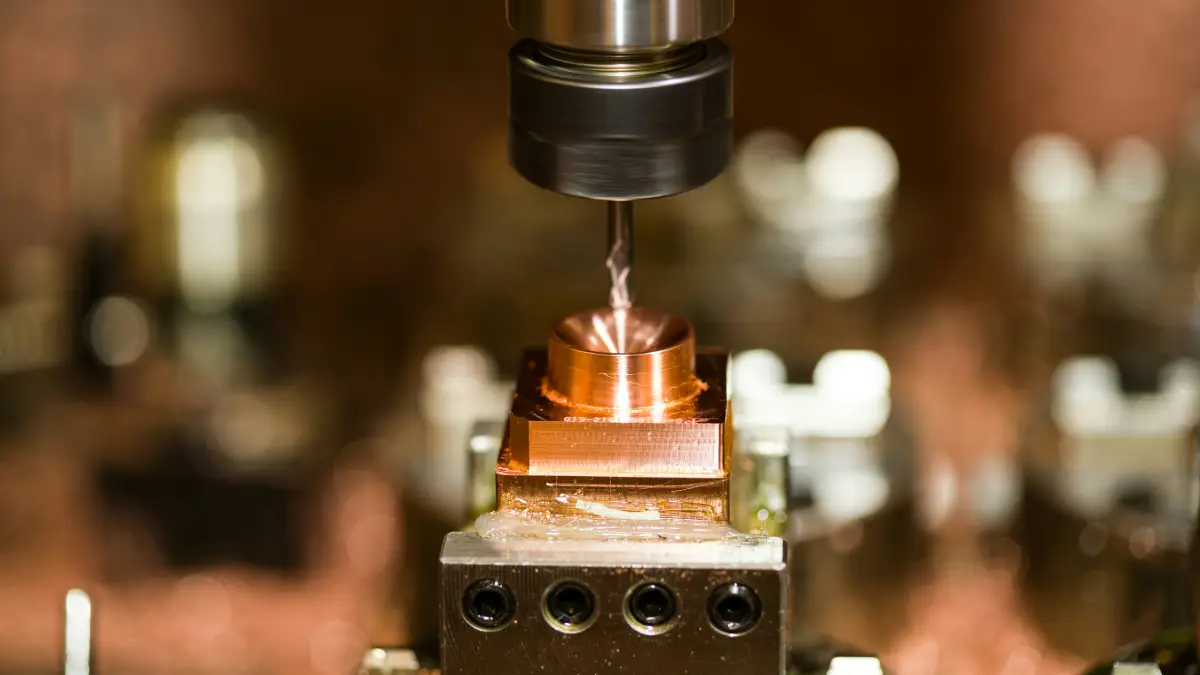
Every part is born twice: first its shape emerges from raw material, and then - in the tool's final passes - its size, smoothness and looks. That second act is finish machining. In this guide we show how it differs from roughing, what the main types of finishing operations are, why hardening appears between the stages, and how the finishing stage decides whether a part passes inspection.
What finish machining is and why the process is split
Finish machining is the final stage of shaping a part: the passes that remove the last tenths and hundredths of a millimetre to give surfaces their final size, smoothness and character. Its opposite is roughing, whose job is fast material removal - as much volume as possible in as little time as possible, with no regard for looks. This split is not an editorial convention but the foundation of process engineering: the textbooks on process design (Feld, Grzesik) treat it as the first decision in planning any operation.
Why can't everything be done in one pass? Because the goals of the two stages exclude each other. Fast material removal needs large chip cross-sections, and those generate forces, heat and deflections that destroy accuracy. Precision needs small forces and stable temperature, which means small cross-sections and a slower pace. Proper machining therefore separates the conflicting goals in time: volume first, quality second. After roughing, the finishing stage receives a part already shaped in the rough, with a small, controlled allowance - and can focus exclusively on size and surface. The CNC finishing operation then takes the part to size in a few light passes.
Roughing and finishing: the differences between the two stages
Rough machining works with a large depth of cut (2-5 mm and more), heavy feed and moderate speed; it leaves coarse tool marks and stresses in the surface layer. The finishing stage is the reverse: depth of cut 0.2-0.5 mm, light feed, higher cutting speed - and completely different priorities. After roughing, the surface finish is inevitably coarse (Ra in the range 6.3-25 µm); after finishing passes, typically Ra 0.8-3.2 µm. The differences show in the tooling too: roughing on a CNC machine uses strong, load-resistant inserts with a large radius, while the finishing stage uses sharp geometries, wiper inserts and high-accuracy tools. Finally the economics: the roughing stage is about the material removal rate, the finishing stage about repeatability. The coarse tool marks left by roughing are part of the plan: they will vanish in the next stage.
The stages of machining in the process plan
The classic machining process plan divides, per the textbooks, into three or sometimes four stages: roughing (removing most of the allowance), semi-finishing (bringing geometry close to final), finishing (size and surface) and - at the highest requirements - superfinishing operations such as lapping. A preliminary skin-removal stage is sometimes separated out when the blank is a casting or forging with a hard crust. The sequence is not rigid: a simple milled part merges the stages in one set-up, while a complex shaft passes through several machines. In shop practice, finishing usually happens on the same machine and in the same set-up as roughing. The key planning rule, however, is always the same: each stage leaves the next a predictable allowance. Typically 0.3-1 mm per side is left for the finishing stage - enough to remove the marks and distortions of the previous stage, and little enough not to waste time. What machining is in the first place, and what motions make up the cutting process, we explain in our separate guide to machining - here we stay with the finishing end of the process.
Material removal vs surface finish: the two goals of the process
The whole machining process can be described as a negotiation between two quantities. The first is material removal - volume per minute, the pace at which the workpiece approaches its final shape; the second is surface finish, what the tool leaves behind. Roughing maximises the first: excess material comes off at full chip cross-section, and productivity is measured in cubic centimetres. Finishing delivers the second: small cross-sections, sharp edges and cutting parameters chosen for smoothness, not pace. For the process planner, the finishing stage has exactly one job with respect to the roughing marks: remove them - no more, no less. Fast material removal and an excellent finish in one pass is a physical contradiction - which is why the process splits into stages instead of seeking a compromise that would serve both goals badly.
In numbers: removing the excess material at the roughing stage can consume 70-90% of the cutting time, but it is the finishing stage that decides whether the part passes inspection. Hence the asymmetry of risk - a roughing error costs time, a finishing error costs the part. The removal rate is the metric of the first stage; the second is measured in microns.
Types of finishing operations
The types of finishing operations are easiest to order from the most common: finishing passes on the same machine that did the roughing, then abrasive operations, then special treatments. The choice depends on the required accuracy, material hardness and geometry - there is no single method good for everything, but there is a logical ladder, and you climb down it only as far as the drawing demands.
Finish turning and milling
The cheapest finishing of parts is simply the last passes on the same machine: finish turning with a sharp, small-radius insert and finish milling with a small allowance. Modern machining reaches IT7-IT8 tolerances and Ra 0.8-1.6 this way without changing the set-up - and every re-clamping is a datum-error risk. Precision machining on a milling or turning centre covers most of industry's needs today; only when the drawing demands more do abrasive operations enter. CNC machining has one more advantage here: the same programs give an identical finish on part one and part one thousand, and the finishing operation works on geometry it knows from the preceding program - a large part of its repeatability.
Grinding
Grinding is the fundamental abrasive operation: the wheel's grains remove micro-chips, delivering Ra 0.2-0.8 and tolerances down to IT5-IT6. It is irreplaceable where the material is too hard for a cutting edge - which is exactly why it forms a natural pair with hardening. Finishing hardened parts is its home ground, and when a finishing pass on the mill or lathe cannot close the accuracy class, the part moves to the grinder too. Flats are ground peripherally or with the face of the wheel, shafts on centre-type grinders, bores on internal grinders. The route is usually simple: rough machining, heat treatment, grinding. The price of this accuracy is a separate machine, a separate set-up and a slow pace - grinding removes hundredths of a millimetre per pass.
Polishing and finishing beyond dimension
When looks or hygiene matter more than dimension, polishing enters: working the surface with soft tools and abrasive paste, descending below Ra 0.1 all the way to a mirror. This kind of surface finishing is the norm in the food and medical industries (micro-valleys harbour deposits) and in injection moulds, where the mould surface prints itself into every shot. The same family includes honing (cylinder bores) and lapping - operations in which surface finishing becomes the goal in itself.
Deburring: manual and mechanical
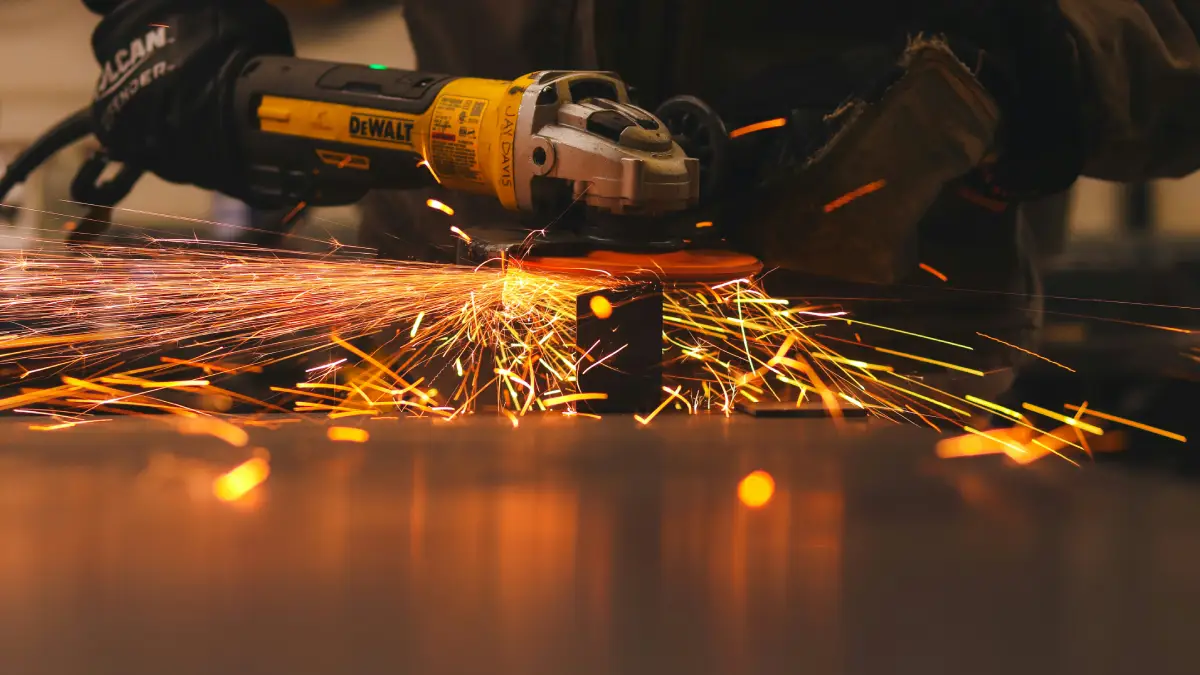
Every machined edge carries a burr - a sharp, irregular remnant that cuts hands, blocks assembly and breaks off in service. Deburring, its removal, is the most underrated type of finishing operation. Manual work (file, scraper, abrasive fleece) still rules for small batches and hard-to-reach edges; it is also often the only option for parts with complex hole intersections. In series production, mechanical methods take over: machine chamfering, brushes, vibratory finishing, blasting. Manual work returns for one-off corrections and prototypes. For small parts, finishing often means deburring and nothing else. The practical rule: if the drawing is silent, "edges broken" is assumed - and a quote that omits deburring understates the labour by up to a dozen or so percent, because manual work does not scale with automation.
Drilling, reaming and precision hole-making
Holes have their own quality ladder. Drilling gives a "raw" hole (IT11-IT13); when more is needed, drilling is followed by rough and finish reaming, which takes the hole to IT7-IT9 and Ra 0.8-1.6. Precision hole-making for bearings or H7 fits is the classic sequence: drill, ream, and where needed fine boring or honing. It is a good example of the general principle: the finishing of a feature is rarely one operation - it is a chain of ever gentler treatments of the same surface.
Power Skiving and gears
A new chapter is Power Skiving - generating gear cutting in which synchronised tool and workpiece spindles cut and finish teeth on a single turn-mill centre, instead of moving the part to a separate shaping machine. Power Skiving shortens the operation chain for internal gears and splines, and combined with hard machining it can replace gear grinding at moderate requirements. For the process engineer it signals a wider trend: modern machining keeps pulling successive finishing operations onto one machine, cutting changeover time and the number of set-ups.
Hardening in the process: finishing after heat treatment
In parts that must be hard - shafts, gears, guideways, tooling - hardening stands between the machining stages. The order is iron-clad: first rough machining of the soft material, then heat treatment, then finishing in the hard state. Reason one: cutting soft steel is cheap, while 55-62 HRC after hardening rules out ordinary inserts. Reason two: hardening distorts - the part warps and its dimensions shift by tenths of a millimetre, so a finish done before the furnace would go in the bin. That is why an allowance is left before hardening (typically 0.3-0.5 mm per side), and after hardening a grinding wheel or CBN inserts remove it - hard finishing with defined edges is today a full alternative to the wheel. Induction hardening and carburising change only the surface layer, but the rule stands: after hardening you may only finish, never shape. If a drawing combines hardness with a tight fit, a process without a hard-finishing stage is simply mis-planned - one of the more common causes of complaints when parts are ordered "on the cheap".
Stainless steel and difficult materials
The material type can overturn these rules, and the special case is stainless steel. Austenitic grades (304, 316) do not respond to martensitic hardening, but they work-harden: a finishing pass that is too shallow, "stroking" the surface, hardens the top layer and accelerates tool wear. Hence the stainless rule: the finishing pass must genuinely cut (depth of cut above the edge radius), with a sharp, positive-geometry tool and a steady feed; stainless cutting parameters are a chapter of their own in the catalogues. Add the stringy chip and poor heat conduction - coolant works harder here than with carbon steel, and roughness after work-hardening can rise instead of fall. A stainless part forgives less, because the parameter window is narrower. Titanium and nickel alloys hold similar traps: the range of materials that can be finished without special measures ends exactly where aerospace alloys begin.
Surface finish quality: dimensional accuracy and smoothness
The result of the finishing stage is described by two families of quantities. The first is dimensional accuracy: the IT tolerance grades, in which typical CNC finishing reaches IT7-IT8, grinding IT5-IT6 and lapping better still. Dimensional accuracy also covers form and position - parallelism, squareness, runout - because the best dimension will not save a warped face. The second family is surface roughness with its Ra and Rz parameters, covered in detail in our article on roughness parameters. One simple cost law links the two families: every step up in quality is an extra operation. A finish of Ra 3.2 comes "for free" from milling; Ra 0.8 takes careful parameters; Ra 0.4 usually grinding; a mirror - polishing. Surface quality rises with every operation - and so does the price - which is why free surfaces that touch nothing can stay at the milled level, while mating surfaces get their finishing planned from the drawing, not from habit. Quality above what the function needs is pure cost: high quality makes sense where a surface mates, seals or is visible - not everywhere. Understood this way, precision machining is not a luxury but a response to specific lines of the drawing.
It is also worth knowing what finishing will not fix. Machining defects from earlier stages - undercuts, datum errors, thermal distortion of the whole body - pass through the finishing stage untouched, or are even revealed when the top layer comes off. Defects are cheapest to catch where they arise; the finishing stage is for smoothness, not for rescuing geometry.
Finishing in practice: parameters and coolant
The finishing operation runs on its own set of settings: small depth of cut, fine feed (it is the feed that sculpts the micro-peaks), a brisker pace than in roughing. Right after roughing, the finishing stage inherits heat and stresses from its predecessor - fresh roughing stresses in the surface layer are still settling, so on accurate parts a pause or cooling between stages is planned in. Cutting parameters for the two stages come from the same catalogues but from different rows, and stable parameters matter more here than brave ones - how they are chosen step by step, we cover in the article on cutting speed. Stability grows in importance at this stage: machine settings must repeat part to part, and CNC machines win here not because they are faster but because they are boring - they do the same thing every time. The settings are written into the process sheet so the stable process can be reproduced months later. Roughing on CNC is planned from spindle power, finishing from rigidity and vibration; the technology of this stage is largely a war on chatter: rigid clamping, short overhangs, a sharp cutting tool. Dimensional accuracy also drifts with temperature - hence air-conditioned halls for the tightest fits.
Coolant plays a different role in finishing than in roughing. There it mainly removes heat; here it guards the part's thermal stability (hundredths of a millimetre "float" with temperature) and flushes chips away so they do not scratch the finished surface. Hardened steels with CBN often run dry; with stainless and aluminium, a well-lubricating coolant directly improves the finish. The minimum principle: coolant delivered precisely into the cutting zone does more than flooding the whole machine.
Tool wear and the workpiece
At the finishing stage, tool wear is measured differently: not by whether the insert still cuts, but by whether it still holds size and smoothness. A cutting tool that would keep working at the roughing stage is already worn for finishing - a dulled edge leaves a worse surface long before catastrophe. Wear is therefore controlled preventively, changing inserts by part count, not by condition. The workpiece sets conditions too: a thin-walled part deflects under cutting forces, so finishing of compliant parts runs at low forces with well-thought-out support; a workpiece after heat treatment needs hard-machining tools, and hard cutting has its own, narrower parameter windows. The material type closes the puzzle - it decides whether the finale is a sharp insert pass or a grinding wheel; the range of materials machinable without special measures ends at the aerospace alloys.
The advantages of machining as a finishing method: one set-up, many gains
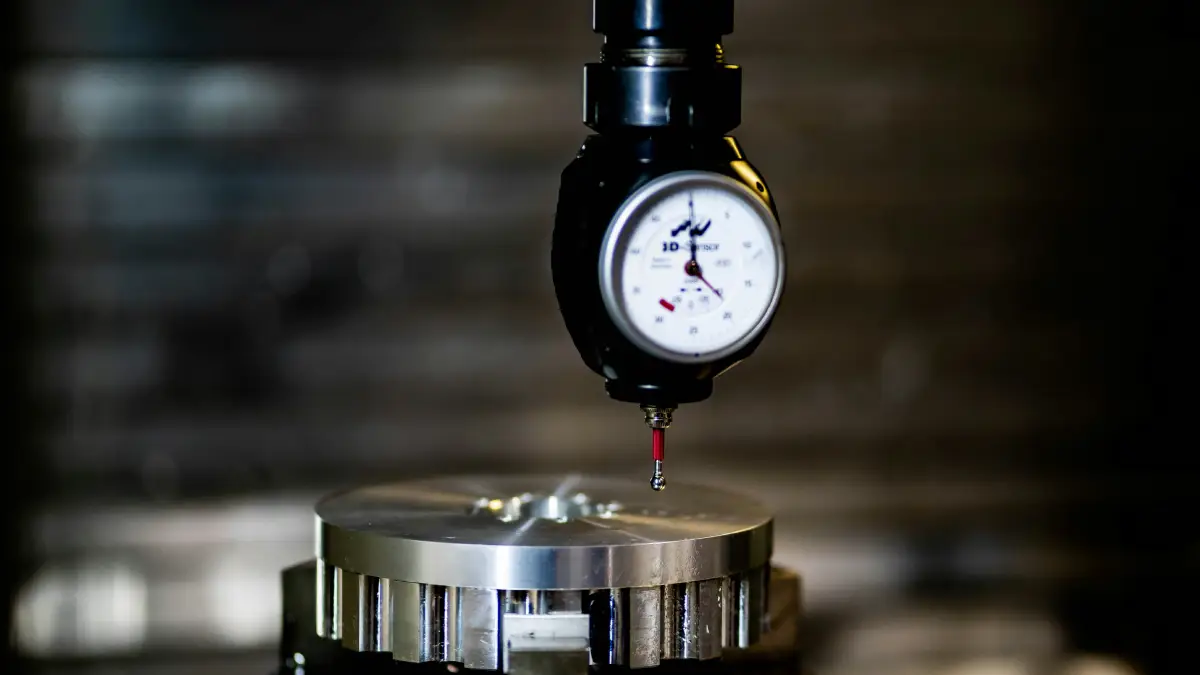
The advantages of machining as a finishing route - against coatings, electrochemical machining or EDM - come down to three things: predictability (geometry follows directly from the toolpath), breadth of application and cost. The gains from finishing on the same machine that did the roughing are even more concrete: no re-datum errors, a shorter overall process, less transport between stations. Finishing then delivers not only size but datum consistency with the roughing stage; it also delivers a series without surprises, because one coordinate system governs CNC machining in a single set-up; modern machining adds in-process probing without unclamping the part. Efficient machining today is exactly this: as many stages as possible in one set-up, with abrasive operations only where the drawing leaves no choice.
Parts throughput and efficient machining
In series production the account is kept in parts: throughput per machine per shift depends on the sum of both stages' times, so they are optimised together. The paradox is that production output - measured at the end of the line, not at one operation - is more often raised at the roughing stage (more aggressive removal of excess material) and stabilised at the finishing stage, because every reject loses all the time the part has already consumed. Production of demanding parts therefore counts from the end: how much time must the finishing stage get so that throughput is not bought with rejects. A miscalculated allowance works the other way round: the finishing stage then removes the roughing marks only partially, and the output drains away in rework. Only then is it decided how fast the roughing stage may run; the productivity of both stages adds up to the cost, but only one of them decides the quality. In this logic, throughput and quality are not opponents - the opponent is the absence of a stage split. Series production closes the account with one number: throughput counted together with rejects is the only honest productivity. A well-calculated stage split raises output more than any single parameter - that is what cost-effective parts production looks like.
Applications and CNC machining services
The applications of finish machining span practically every industry where parts carry toleranced dimensions: automotive (journals, bearing seats), hydraulics (machining of sealing faces and bores), aerospace (machining of complex pockets with 0.5 mm walls), medicine, where precision machining of implants is subject to validation, and injection moulds - there, after the roughing passes, CNC finishing with ball-nose cutters descends to Ra 0.4 without hand-finishing and closes the machining of the forming surfaces. The more complex geometries become the norm, the larger the share of a part's value created at the finishing stage - the types of machining used in one process now number half a dozen: milling, boring, reaming, threading, abrasive work, deburring - and practically all of them have their finishing variants. Machining of complex housings runs on CNC machines with probes that measure the part between stages.
CNC machining covers this whole ladder today, from roughing to finish, and roughing plus finishing on one machine is the standard of machining centres. For the buyer the payoff is simple: CNC machining services differ not in whether a supplier owns machines, but in how well it controls the finishing stage - that is what decides the dimensions on the inspection report. When quoting a part, it is worth knowing how much work the tail of the process will eat: our instant CNC quoting breaks the time down by operation and shows how tolerances and finish translate into price - before the drawing reaches the shop. Parts with tight requirements always cost more not because of the material, but because of the end of the process.
Frequently asked questions about finish machining
How does roughing differ from finishing? In goal and parameters. Roughing maximises the material removal rate: large depth, heavy feed, coarse finish. Finishing delivers size and smoothness: small allowance, fine feed, sharp tool. The finishing stage works on a 0.3-1 mm allowance left by roughing - separating the stages is the foundation of every sound process.
What does a machining process plan look like? A sequence of stages linking different types of machining into one routing: roughing, semi-finishing, finishing, sometimes superfinishing - with heat treatment slotted between them; castings and forgings add a preliminary skin-removal stage. Each stage leaves the next a controlled allowance, and the plan is built backwards from the drawing's requirements; CNC machining lets the character of the work change with the program alone.
What is hardening between the stages for? It gives hardness the soft material lacks - but it distorts the part and hardens it beyond ordinary tools. That is why it is done after roughing, leaving an allowance for the grinding wheel or hard machining to remove afterwards.
What is deburring and when is it done by hand? It is the removal of sharp burrs from machined edges. By hand - for small batches, prototypes and edges no machine can reach; in series production, mechanical methods take over, from chamfering to vibratory finishing.
Can turning be a finishing operation? Yes - a sharp insert reaches IT7 and Ra 0.8-1.6, and CBN inserts finish even hardened steels, replacing the wheel. It is fully-fledged precision machining; the conditions are a rigid set-up and a small, stable allowance.
How much allowance is left for material removal at the finishing stage? Typically 0.3-1 mm per side after roughing and 0.3-0.5 mm before hardening. Too little - the previous stage's marks will not disappear; too much - the finishing stage works like roughing and loses accuracy.
When does finishing require a grinder? When dimensional accuracy must be tighter than IT7, smoothness below Ra 0.8, or the material is hardened. Below those thresholds, the finishing passes remove the roughing marks with a mill or turning tool - cheaper and in one set-up.
Will finishing fix errors from earlier stages? No. The finishing stage's small allowance removes tool marks but will not correct geometry or datum errors - those must be eliminated where they arise.
Why does surface finish raise the price of a part? Because every smoothness threshold is an extra operation: more careful passes, the grinding wheel, polishing - and extra quality inspection. Requirements are best set by function, not aesthetics: where a surface touches nothing, a coarser finish is simply cheaper.
Topicsfinishingmachiningtechnology
Sources
- 1.M. Feld, "Podstawy projektowania procesów technologicznych typowych części maszyn", WNT (process stages, inter-operation allowances)
- 2.W. Grzesik, "Podstawy skrawania materiałów konstrukcyjnych", WNT (finishing and the surface layer)
- 3.W. Olszak, "Obróbka skrawaniem", WNT (types of finishing operations)
- 4.R. Wołk, "Normowanie czasu pracy na obrabiarkach do obróbki skrawaniem", WNT, Warsaw 1972 (roughing/finishing split in time norms)
- 5.Sandvik Coromant, "Training Handbook: Metal Cutting Technology" (hard machining, Power Skiving)
- 6.K.G. Swift, J.D. Booker, "Manufacturing Process Selection Handbook", Butterworth-Heinemann, 2013 (achievable tolerances and Ra by process).
Read next
- Cutting Speed: Definition, Selection and PracticeCutting speed decides the temperature in the cutting zone, tool wear and machining cost. We explain how it differs from RPM and how to choose it well.
- Cutting Parameters Calculator: Speed, RPM and Feed ExplainedCutting speed, spindle RPM and feed - these three numbers decide tool life, surface quality and machining time. We show the formulas, worked examples and typical values you can plug straight into a cutting parameters calculator.
- Cutting Tools: Types, Design and How to Choose the Right OnesTurning tools, mills, drills and saws - cutting tools do all the real work on a machine tool. We explain tool types, design and materials, and advise how to choose the right tool for the operation.
Try it on your own part
Create an account, upload your STEP files and compare the quotes with your own. First 14 days free, no card.
Create a free account