Technology
Machining: How Metal Cutting Works, Types, Accuracy and Applications
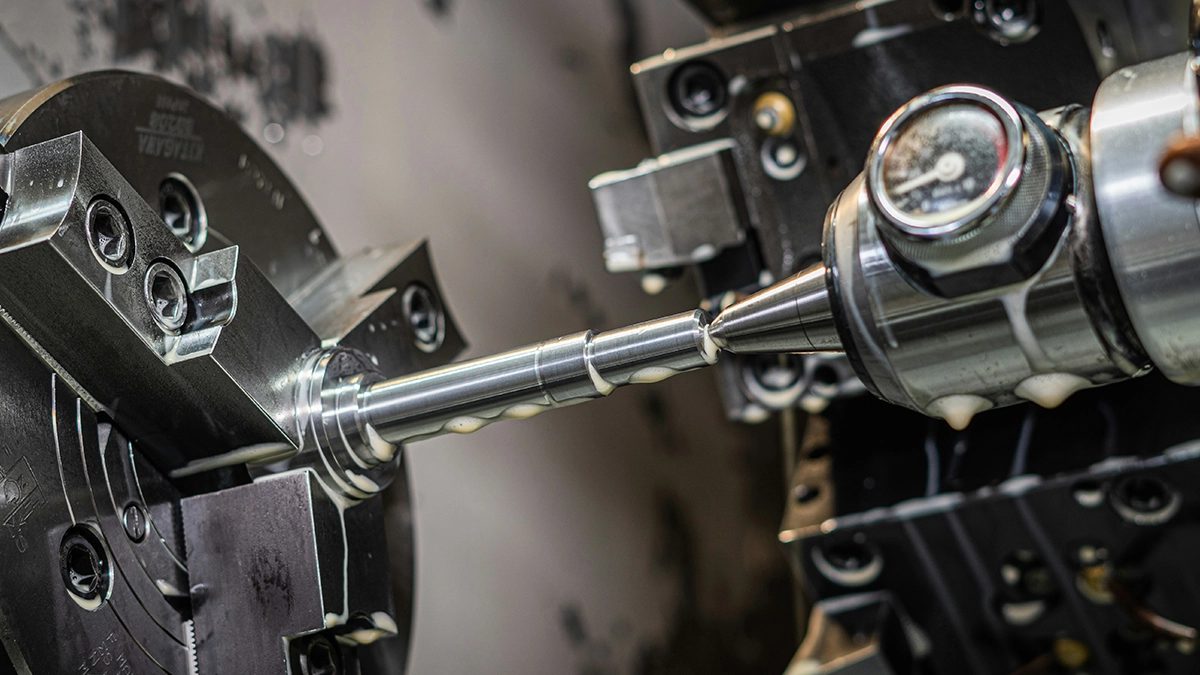
Machining is the oldest and still the most important way of giving machine parts their final shape: controlled removal of material with a cutting edge, layer by layer, until the part reaches the dimensions, form and finish on the drawing. In this guide we look at it from the technology side: how the cutting process works, what the types of machining and chips are, where accuracy comes from and where precision machining earns its keep every day. How ordering and quoting such production works is covered separately in our article on CNC machining.
How machining works
Machining (also called chip-forming or subtractive machining) is a type of material-removal process: the shape is obtained by removing material in the form of chips with a wedge-shaped cutting edge. Subtractive processes also include erosion methods, but it is cutting - the precise shaping of materials by shearing off successive layers - that forms the mainstream.
Machining requires the combination of two motions: the primary motion, which supplies the energy (rotation of the workpiece on a lathe or of the tool on a milling machine), and the feed motion, which moves the cutting zone to new material. At the point of contact the edge is forced into the workpiece material, shears it along a slip plane and carries the surplus away as a chip - that is essentially the whole cutting process, whether we are talking about a giant vertical lathe or a hand file.
This removal of material layers is both the strength and the weakness of the method. The strength, because cutting can produce almost any geometry from almost any engineering material, with an accuracy unreachable for casting or forging. The weakness, because removing surplus material costs time, energy and tools, and a chip is bought material turned into scrap. That is why the purpose of machining in modern production is defined pragmatically: remove exactly as much as needed, as fast and as cheaply as possible, while keeping the required accuracy.
Chip types
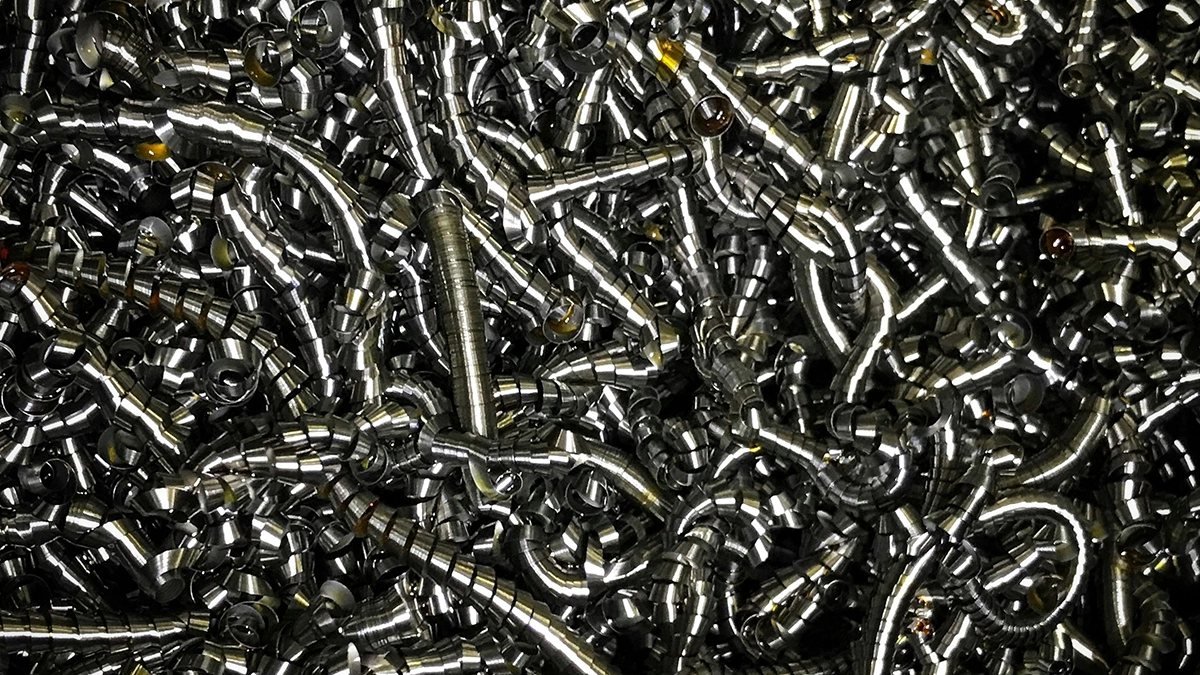
The chip is the process's calling card, and an experienced machinist reads it like a book. The classic literature distinguishes three basic chip types. The continuous (ribbon) chip forms when cutting ductile materials at higher cutting speeds: it signals a stable cutting process, but a long ribbon can wrap around the tool, which is why inserts have chipbreakers. The segmented (serrated) chip shows visible, partly joined segments and accompanies materials of lower ductility and difficult-to-machine alloys such as titanium or hardened steels. The discontinuous chip breaks into short elements and is typical of brittle materials: cast iron, brass, some plastics. Shape and colour suggest corrections: a dark-blue ribbon warns of excessive temperature, and fine needles from a ductile material usually mean the feed is too low.
Types of machining
Machining divides into two great families. Chip-forming machining uses cutting tools with a defined edge geometry (turning tool, mill, drill) and removes relatively thick layers; these are the basic forms of the technology. Abrasive machining works with grains of undefined geometry (grinding wheel, belt, paste) and takes off layers in the micrometre range, delivering high accuracy and finish.
Machining also divides by the degree of mechanisation: manual work (filing, scraping, deburring) plays a supporting role today, machine work on conventional machine tools needs the operator's constant attention, and mechanised machining - with CNC as its highest form - hands the guidance of the tool over to the machine; machine work has displaced handwork everywhere except finishing touches. All variants share a common denominator: mechanical cutting removes material by force, through physical contact of edge and part. Below, the most important methods and techniques in practice.
Turning
In turning the primary motion is performed by the rotating workpiece, while the tool moves along or across the axis. It is the first-choice method for rotational parts: shafts, sleeves, flanges, screws. Traditional turning on a universal lathe lives on in tool rooms and for single pieces, but the production standard is CNC turning: numerical control guides the tool along any contour, treats milling as a natural complement, and live tooling adds milled slots and drilled holes in one setup. More about turning tools in our guide to cutting tools.
Milling
In milling the primary motion is performed by the rotating multi-edge tool, while the part (or the tool) travels in three axes. Milling is the most universal method: faces, pockets, slots, gear teeth, freeform surfaces. CNC milling in 3, 4 and 5 axes is the machining of complex shapes that no other subtractive method can produce, and multitasking centres now combine milling and turning to make a finished part from bar stock without re-fixturing.
Drilling
Drilling and its relatives (reaming, counterboring, tapping) account for holes, statistically the most common geometric feature of machine parts. Both motions are usually performed by the tool. Choosing RPM and feed for drills is covered in our guide on calculating cutting speed and feed, because drilling is where beginners most often overdo the cutting speed.
Abrasive machining
Abrasive machining (grinding, honing, lapping, polishing) takes over where chip-forming machining ends: it is surface finishing for hardened materials, requirements below 0.4 and tolerances of single micrometres, based on removing material layers of micrometre thickness. Grinding is also the only practical way of machining hardened surfaces, which is why the typical routing reads: rough machining, hardening, grinding to finish.
Machining stages and the process plan
A part rarely appears in one pass; the machining process plan divides the work into stages with different goals, and the goal at every stage is different. Preliminary operations (cutting off, facing, centre drilling) prepare the blank and establish the datums that every following operation returns to.
Roughing removes the bulk of the allowance: what counts is the material removal rate, not finish, so it runs at large depths and feeds. A typical part passes three or four such stages. Semi-finishing brings the part close to size, leaving a small, even allowance. Finally finishing establishes the final dimensions and surface: small allowances, higher speeds, lower feeds. The same methods return at successive stages, only with different parameters, and without solid preliminary operations there are no accurate datums for the rest. This division is not art for art's sake: each stage leaves the part in a state the next one can improve predictably, and separating roughing from finishing limits the effect of deformation and residual stress on the final result.
A complete machining process plan covers more than tool passes: blank selection, sequence of operations and setups, choice of datums, heat treatment between stages, and inspection. Classic textbooks devote whole chapters to datum selection alone, because a datum error can wreck the accuracy of every operation. In practice the process is written down as a routing, or process sheet: operation by operation, with machine, tools and times. A well-designed plan makes sure accuracy grows with every stage and the stresses from roughing do not spoil the finishing result.
Machining accuracy and accuracy grades
Accuracy is described by IT tolerance grades according to ISO 286: the lower the number, the tighter the tolerance. The practical grades look like this: roughing delivers IT12-IT14, semi-finishing IT9-IT11, finishing on CNC machine tools IT7-IT8, and grinding with fine abrasive processes IT5-IT6.
For a 50 mm shaft, grade IT7 means a tolerance zone of 25 micrometres - half the thickness of a human hair; that is the high precision cutting is about. Dimensional accuracy goes hand in hand with finish: typical finishing leaves a roughness of 0.8-3.2, and a surface below 0.4 already calls for abrasive methods, as discussed in our article on surface roughness.
Where does accuracy come from? From the whole machine-fixture-workpiece-tool system. Precision machining begins with the stiffness of that system, because mechanical cutting always introduces forces and heat, and the course of the process decides where those deformations accumulate. Machine rigidity, edge wear, temperature, cutting forces and datum choice all contribute to the error budget. That is why accuracy is always a trade-off with cost: every IT grade down raises the price, demanding slower parameters, extra operations and tighter inspection. From the buyer's perspective the rule is the same as with roughness: high precision where the function demands it, looser everywhere else - see our article on tolerances and machining cost.
Materials in machining
Metal machining is the mainstream: structural and alloy steels, stainless steels, cast irons, aluminium and its alloys, copper, brass, titanium, nickel superalloys. The harder the workpiece material, the lower the parameters and the more expensive the tools; modern machining, however, copes even with superalloys and hardened steels.
Metal machining competes with other metalworking methods - casting, forging, forming - and wins wherever accuracy matters. Each material has its character: aluminium cuts fast but loves built-up edge; stainless steels work-harden under the edge; titanium conducts heat poorly; cast iron dusts with a short discontinuous chip. Machinability is organised into the ISO 513 groups (P, M, K, N, S, H), which structure the choice of tools and parameters. CNC machining of non-ferrous metals needs different tools and strategies than steel. And metal is not the whole story: machining of plastics and composites grows with their share in products and demands its own tools, because plastics flow under the edge and melt from heat, while precision machining of brittle materials such as graphite or ceramics is the domain of grinding and diamond tools. In short, almost every engineering material can be machined; only the tools and parameters change.
CNC machining: the modern methods
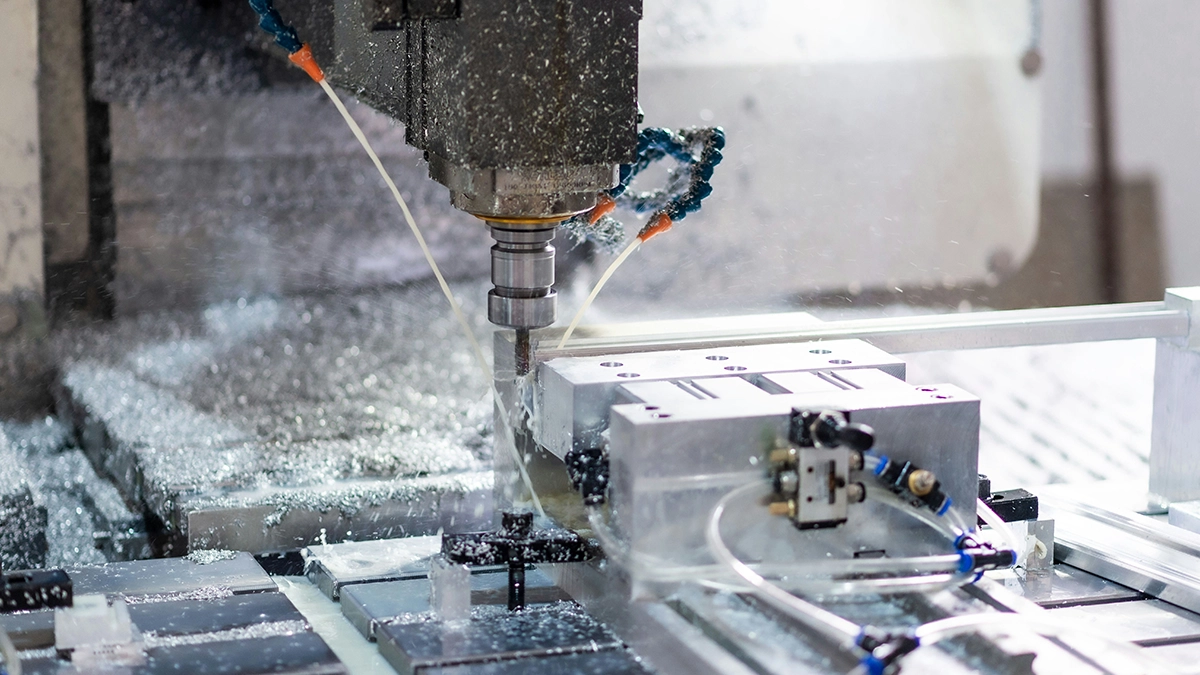
Modern machining means, above all, CNC machine tools. Numerical control turned a craft into a repeatable process: a program runs identically every time, and machine cutting achieves accuracies out of reach for the human hand. CNC turning and CNC milling form its core, and in many shops CNC milling has become the axis of the whole machine park.
CNC machines guide the tool along a path written in G-code, and five-axis simultaneous cutting machines the complex shapes of blades, moulds and implants. Modern machining also reaches for new technologies: high-speed machining (HSM), hard machining that replaces part of grinding, and adaptive CAM strategies that keep tool load constant; it is also a digital CAD-CAM-machine chain with no paper in between. Add the automation of the process - bar feeders, robots, measuring probes and lights-out operation - and you get fully mechanised machining. Its efficiency is measured no longer by whether a part can be made, but by cycle time and cost per piece; that is why CNC displaces conventional methods wherever series matter. Precision CNC machining is a standard today, not a luxury, and it defines what the technology can do in the 21st century. We described this world from the practical, business side in what CNC machining is.
Advantages and disadvantages of machining
Machining offers versatility in materials and geometry, accuracy and surface quality beyond non-subtractive methods, a short path from CAD model to part without moulds, and repeatable quality thanks to CNC. Its drawbacks are material waste (up to 90% of a billet when machining from solid), time, geometric limits, and stress and heat in the surface layer.
Advantages
Universality of material and geometry: from soft plastics to hardened steel, from plain sleeves to complex shapes. Accuracy and surface quality unreachable for non-subtractive methods. Precise shaping of materials without moulds or tooling means a short path from CAD model to finished part, making it ideal for prototypes and short runs; machine cutting also scales without investment thresholds. CNC machines have democratised precision: mechanised cutting eliminates the variability of the human hand, so repeatable machining delivers predictable quality in part production of any batch size. And finally scalability: the same technology handles one piece and a hundred thousand. The wide use of machining across industry follows directly from this set of advantages.
Disadvantages
Material consumption: removing material means part of the purchased stock ends up as chips - machining from solid can turn 90% of an aerospace billet into swarf. Time: shaping material layer by layer is slower than casting or injection-moulding the final shape, so efficiency drops at huge series of simple shapes and machining loses on cost there. Geometric limits: its possibilities end where the edge cannot reach, so internal channels of complex routing are made by 3D printing or casting. Add the stresses and heat introduced into the surface layer, which for thin-walled parts demand a well-thought-out sequence of operations. Choosing between cutting and another subtractive or non-subtractive method is simply arithmetic: geometry, material, batch, required accuracy. Modern machining has softened these drawbacks, but not abolished them.
Machining in production: applications
It is hard to find an industry without cutting. Automotive is the high-volume classic: series production of parts such as engine blocks, shafts and gearbox housings, where mechanised machining in transfer lines and CNC turning in cycle times of seconds decide the cost per piece, and efficiency is measured by the takt of the whole line.
Aerospace machines structures from light alloys and titanium, often cutting away 90% of the billet, plus superalloy blades. Power engineering needs large-scale machining of turbine shafts and casings, and the medical industry needs precision machining of implants and instruments, where high precision meets difficult alloys; it is the medical industry that audits suppliers hardest and where the use of machining grows fastest. Add agricultural machinery, rail, hydraulics, automation and tool shops, where CNC milling of moulds is daily bread - the scope of machining is as wide as the production of machine elements in every manufacturing process. Metal machining serves each of these industries, the technologies evolve together with the materials, the possibilities grow with every machine axis, and modern machining can now be seen in every other Polish plant. The techniques are matched to the branch: machining complex, thin-walled aerospace structures looks nothing like machining a gearbox housing.
Machining works just as well in one-off and small-batch production as in large series, because CNC removed most of the preparation costs. Commercially, the Polish machining market stands strong: thousands of companies from one-man workshops to plants with hundreds of machines, strong exports to Germany and Scandinavia, and a constantly growing CNC machine park; CNC machining of metals is the most commonly offered service. Machining companies now quote in days, not weeks - and in MetronQ the quote happens automatically from the model and requirements, so instead of waiting days for offers you see the price at once; indicative rates are in the pricing section. For a machine shop, what such a configurator on its own website changes in the contest for orders is described in winning more CNC orders with online quoting.
Frequently asked questions about machining
What exactly does "to machine" a part mean?
It means shaping the part by controlled removal of material with a cutting edge, with the chip as a by-product; it is mechanical cutting, as opposed to erosion or chemical methods. It applies both to raw blanks (bar, forging, casting) and to parts from other processes that need accurate surfaces.
What are the main machining methods?
Machining covers turning (rotational parts), milling (faces and 3D shapes), drilling with reaming and tapping (holes), and abrasive machining: grinding, honing, lapping. Broaching, slotting and gear cutting complete the picture as rarer techniques. All share the principle of a wedge removing a chip and differ only in kinematics.
How does CNC machining differ from conventional?
In the control: on a conventional machine the operator guides the toolpath, on CNC a program does. CNC gives repeatability, multi-axis work and automation, and the operator supervises instead of turning handwheels. It has not entirely displaced conventional machines, though: for regeneration work and simple single pieces a universal lathe is still sometimes faster.
Which materials are machined most often?
In a typical shop: structural and stainless steels and aluminium; then cast iron, brass, titanium and plastics, with non-ferrous machining growing alongside electromobility. Machinability is organised by the ISO groups, from easy aluminium (N) to difficult superalloys (S) and hardened materials (H), and tools and parameters follow the group.
Why does one bar take several operations instead of one?
Because the stages have conflicting goals: roughing maximises material removal and introduces forces and heat, while finishing needs calm conditions for accuracy, and preliminary operations establish the datums. Separating them, sometimes with seasoning or heat treatment in between, stabilises the part's dimensions, so the process is planned up front in the routing.
What is the difference between turning and milling?
In turning the workpiece rotates, while in milling the multi-edge tool rotates. Turning is chosen for rotational parts, milling for the rest of the geometry. Traditional turning and milling increasingly meet on one multitasking machine, which performs them alternately in a single setup, turning a bar into a finished part.
What do chip types say about the process?
A chip is free diagnostics: a ribbon chip means ductile, stable cutting, a segmented chip appears with difficult materials, and a discontinuous one with brittle materials. Colour and shape suggest corrections: discolouration signals excessive temperature, and a tangle of ribbons points to a problem with the chipbreaker or feed.
When is machining the wrong choice?
Despite its wide use, machining loses with huge series of simple shapes (cheaper to cast, mould or stamp), with complex internal channels unreachable for the tool (3D printing wins there), and where it would turn precious metals or expensive alloys into chips. In practice the methods are combined: a casting or print is machined only on functional surfaces.
Sources
- 1.W. Grzesik, "Advanced Machining Processes of Metallic Materials", Elsevier
- 2.K. Jemielniak, "Obróbka skrawaniem", Warsaw University of Technology Press
- 3.M. Feld, "Podstawy projektowania procesów technologicznych typowych części maszyn", WNT
- 4.ISO 286 - IT tolerance grades
- 5.ISO 513 - Classification of workpiece materials P/M/K/N/S/H
Read next
Automatic CNC machining quotes
Priced from the 3D model or the drawing, on your machines and your rates. You just approve it. 14 days free, no card.
Create a free account