
Machining Quotes: What Drives the Price
· 27 min read
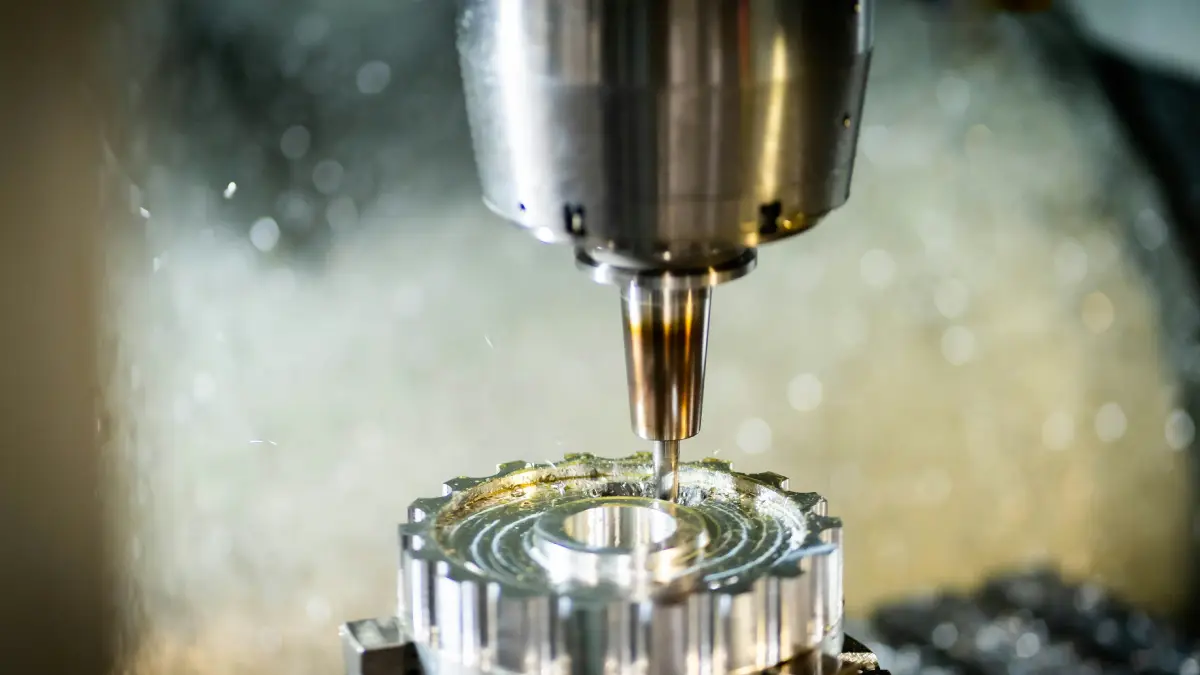
Two shops, the same drawing - and two prices that differ by half. First-time buyers usually suspect a mistake; experienced ones know both quotes can be honest. The price of a part is the product of the machine, the batch, the material and the risk, and the factors driving a quote are often invisible at first glance. In this guide we take the cost of a machined part apart: what the price is made of, why a part in a batch costs a fraction of a prototype, and how to prepare an enquiry so the offer comes back fast and free of "to be confirmed" footnotes.
CNC machining quotes: how much does CNC machining cost
There is no single answer to "how much does CNC machining cost", but there is a single calculation. Every honest CNC machining quote reduces to four components: material, machine time multiplied by the hourly rate, production setup costs spread over the parts, and a margin covering risk and profit. CNC (Computer Numerical Control) machines differ in rates, but the logic is the same on every machine - from a garage shop to a hall full of machining centres.
Material cost is the simplest line: blank mass times price per kilogram, plus offcut. More interesting is the ratio of machining cost to material - on a simple S355 steel shaft, material can be half the price; on a complex housing milled from an aluminium block it may drop below ten percent, because eighty percent of the blank leaves as chips. The second line is time: a machine-hour with an operator runs from roughly 35 to over 100 EUR depending on the machine and region - labour costs, depreciation and energy are baked into the rate. The third is setup: CNC programming, fixturing, tooling, the first article. The fourth is margin - different at every supplier, and discussed honestly below.
How does anyone know how long a part will take? That used to be answered by time-norm tables and the process engineer's experience; how the craft evolved from paper tables to algorithms is the story of our article on CNC quoting. Here we focus on practice: what exactly the buyer pays for and what they can influence.
How to calculate CNC machining cost
The basic formula: cost = material + machining time × hourly rate + setup costs / number of parts. Machining time covers more than cutting: tool changes, measurement and changeovers count too - why exactly those minutes are the priciest is explained in our piece on the most expensive minute in CNC machining.
Three clocks tick inside the setup cost. CNC programming time - from minutes for a simple bushing to days for a 5-axis housing. Changeover time - machine settings, fixtures and tools for this particular part. And the first article, which always runs slower because the program must be proven. All three are fixed regardless of order size - and they are what separates the price of the first part from the hundredth.
CNC cost calculation in practice
A professional CNC machining calculation starts from geometry, not intuition. The process engineer (or the algorithm) splits the part into operations: what can be turned, what must be milled, where the holes are - the type of operation decides the machine, and the machine decides the rate. For each operation the time is estimated from the volume of material to remove and the cutting data; CAM systems compute it directly from toolpath length. Then come auxiliary times and setup. What distinguishes a real CNC cost calculation from a guess is that every line has a source: a volume, a toolpath, a catalogue feed rate.
Turning costs are the easiest to calculate - a body of revolution has simple geometry and predictable times. Milling is harder, because time depends on strategy, not just shape. The split between roughing and finishing matters too: roughing removes volume fast and cheap; finishing is slow, because it runs on parameters chosen for quality.
CNC part price and unit price
Unit price is the most misleading concept in the whole topic, because it does not exist independently of quantity. The same part can cost 90 EUR as a single piece and 15 EUR in a batch of fifty - and both figures are "the unit price". The reason: fixed costs spread over the batch. With one part, programming and setup load it entirely; with fifty, one fiftieth each.
That is why one-off quoting follows its own rules: setup dominates and the cutting itself recedes. Production batches invert the proportion. The practical takeaway: if you know you will need more parts next month, ask for several quantity breaks at once - a one-off quote and a batch quote from the same drawing can differ fivefold per piece, and the unit cost falls fastest between 1 and 20 parts.
What drives a machining quote
The factors behind a quote fall into three groups: what we machine (material), how many times (batch) and how hard it is (geometry, accuracy, extra operations). Below in turn - each group works on the price through a different mechanism.
Machining price vs the material
The workpiece material affects the price twice: once as a purchase, once through machinability. Free-cutting steel and aluminium machine fast and cheap; stainless steel demands slower parameters and more frequent insert changes; titanium or Inconel can stretch machining time severalfold against steel for the same geometry. Availability matters too: an unusual grade in an unusual blank size can cost more than all the machining.
Some parts call for choosing the material together with the supplier - when the designer picked a grade from memory and an equivalent with identical properties is half the price and in stock. Others hinge on material availability: when the deadline is tight, the shop buys the blank with express delivery, and you see it in the offer. Good practice: for non-standard grades, ask whether an equivalent is acceptable.
Batch size: one-offs and series
Batch size is the strongest single lever on price. One-off production pays the full setup bill; series production spreads it over the parts and lets the process be optimised - different fixturing, different tooling, fewer measurements per part. There are even parts quoted with changeover formulas: recurring items priced on the assumption that the program and fixtures already exist, so only the changeover time is charged.
A simple heuristic: if setup costs 70 EUR and machine time per part costs 9 EUR, a part in a batch of 10 comes to about 16 EUR, and a single piece to 79 EUR. Nothing in that arithmetic is margin or a "penalty for small orders"; it is pure fixed-cost accounting.
Part complexity, tolerances and quality control
The third group is difficulty. Complexity is measured in operations, changeovers and the number of sides to machine: geometrically complex parts need many setups or expensive multi-axis machining. Accuracy demands are a separate line: dimensional tolerances under 0.02 mm, H7 fits, low surface roughness requirements - each such callout means slower parameters, extra operations and measurement. We dissect this in tolerances vs CNC machining cost; here, the principle: you pay not for the dimension but for the annotation next to it.
Quality control belongs to difficulty too. Parts requiring CMM inspection with a measurement report and material certificates cost more than the same parts "without papers" - measurement and documentation time is real work. Parts requiring higher accuracy than the workshop standard (ISO 2768-m) should always be toleranced deliberately: a drawing where every dimension carries tight tolerances "just in case" can double the quote with zero design benefit.
CNC turning quotes and turning prices
A CNC turning quote is the simplest in the whole machining family - which makes it the best place to watch the pricing mechanics. A body of revolution has computable volume, cycle times follow directly from cutting data, and chucking is fast. How much does CNC turning cost? Lathe rates start around 30-40 EUR/h for simple 2-axis machines and rise to 60-90 EUR/h for turn-mill centres with driven tools. Add material and setup - a complete quote for a simple 40x60 mm S355 bushing as a single piece is typically 20-35 EUR, and in a batch of 100 the price can fall below 5 EUR.
A turning quote is built from the same four lines as everything else, but the proportions are characteristic: short programming, quick changeover, a large material share. With simple turned parts, most depends on the blank and the batch, less on the geometry itself. What pushes a turning quote up are the special operations: finish turning to tight tolerances, deep holes, threaded features with non-standard profiles, or parts needing tailstock or steady-rest support.
The technology itself - kinematics, tools, entering angles and parameters - is the subject of our separate guide to longitudinal turning; here we look at turning purely through the lens of cost.
What builds the cost of CNC turning
The cost climbs in steps, with each added requirement. Rough turning is the machine's cheapest work: big chip sections, short time. The boundary between roughing and finishing is the allowance - roughing is paid for in removed volume, finishing in quality. Finish turning is slower, because feed and depth give way to quality; if the drawing calls for surface roughness Ra 0.8, the machine spends visibly longer than for Ra 3.2. The next step is fits and narrow tolerances - finish turning for H7 often ends with measuring every part. Then come the auxiliary operations: axial and radial drilling, threading and multi-axis work on centres with a C axis, which turn a lathe into a combine - convenient, but pricier per hour.
One thing worth remembering: you will learn what turning costs from the drawing faster than from a price list. That is why an honest turning quote starts from the drawing: two parts of identical volume can differ threefold in price if one has open tolerances and the other has fits, grooves with undercuts and chamfers, and a trapezoidal thread.
Turning aluminium, stainless steel and brass
Material changes lathe economics more than the bar price alone suggests. Turning aluminium is fast: high speeds, low forces, long insert life - so aluminium comes out cheapest per cubic centimetre removed despite the pricier blank. Brass is the classic of turning automatics: a short, brittle chip and superb machinability make brass sometimes even faster than aluminium, though the material costs more; high-volume brass turning lives on dedicated Swiss-type machines. Bronze behaves similarly in the cut, but cast bronze blanks are expensive and slow to source - a common case of material beating labour; bronze is therefore always quoted with the material, never "labour only". At the other end stands stainless steel: parameters drop by a third against carbon steel, tools wear faster, and the stringy chip needs breakers.
Steel turning spans two different price realities: carbon and stainless. The reference point is always structural steel - S235, S355, C45 are what price lists are calibrated on. Taking structural steel as 100%: aluminium 70-85%, brass 65-80%, stainless 130-170%, titanium 250-400%. Good price lists quote ranges per material group and price carbon and stainless separately; hard-to-machine metals always need an individual calculation.
Milling, drilling and threading in the quote
CNC milling is harder to quote than turning, because time depends not only on geometry but on strategy. The same pocket can be milled in layers or trochoidally - with different times and tool wear. CNC milling costs therefore depend more than turning on who runs what: a 3-axis CNC mill from the 2000s and a new high-speed centre will price the same part completely differently. Hourly rates: a simple CNC mill runs 35-60 EUR/h, 5-axis machining 70-120 EUR/h.
The number of machined sides matters. Standard 3-axis machining covers most parts, and 3-axis work in a single setup is cheapest; every flip is a changeover, a datum risk and extra time. With five or six sides, 5-axis machining can paradoxically be cheaper than 3-axis, because one setup replaces four. Then come drilling operations - cheap while standard (through hole, metric thread), pricier for deep and toleranced holes. CNC milling services are always quoted from the 3D model, not from 2D views, and normally include machine-cycle threading; only large-diameter and fine-pitch threads in hard materials cause trouble.
CNC milled features: pockets, slots, contours
Milled features have their own economy of shapes. Pocket milling costs more the deeper the pocket and the smaller the corner radius - an internal radius of 2 mm in a 40 mm deep pocket demands a slender cutter at a crawl, so changing the radius from 2 to 6 mm can halve the operation's cost. Slot milling is cheap as long as the width tolerance allows a standard cutter. Contour milling is the most rewarding operation: rigid tool, full engagement, time predictable from toolpath length. In series work on small milled parts, the bottleneck is often part handling rather than cutting - which is why they are fixtured several at a time in one vice or on a pallet.
Secondary operations and parts that demand more than standard
Secondary operations are everything that happens after the part leaves the machine: heat treatment, anodising, blackening, painting, grinding. They appear in the quote as separate lines - often subcontracted - and follow their own logistical minimums: a plating shop charges per load, not per part, so galvanic or surface treatment of a single part can be absurdly expensive per piece, and in a batch it almost vanishes from the bill. Declare post-machining operations in the enquiry up front; a secondary operation added after the fact usually ruins both schedule and price.
Typical categories that push a quote above standard:
- Tight-tolerance parts - fits, hundredth-of-a-millimetre dimensions, flatness or coaxiality callouts; each means slower machining and measurement.
- Geometrically complex parts - freeform surfaces, undercuts, thin walls; more operations and higher scrap risk.
- Parts needing geometry analysis before quoting - models mangled by format conversion, scans, imported surfaces; someone must repair or interpret the geometry before a price exists.
- Multi-operation parts - turning plus milling plus grinding; every machine change is transport, fixturing and a queue.
- Heat-treated parts - hardening or nitriding mid-process splits machining into "before" and "after", with a second setup and hard finishing.
- Surface-treated parts - anodising, zinc plating, powder coating; add transport and the plating shop's batch minimum.
- Decorative plating - bright chrome or nickel demands prior polishing, which costs more than the coating itself.
- Precision-threaded parts - 4H/6H thread tolerances, trapezoidal and multi-start threads; special tooling and gauge inspection.
- Parts requiring inspection reports - CMM protocols, PPAP, certificates; an hour in the measuring room costs as much as an hour of machining.
- Parts requiring higher accuracy than ISO 2768 overall - the whole part moves to a slower machining regime, not just one dimension.
- Parts needing special machine setup - dedicated fixtures, soft jaws; the quote includes making them.
Secondary operations have one more trait: their own logistical minimums and lead times that must fit the schedule. From quoting practice: tight-tolerance and surface-treated parts come back most often, followed closely by precision threading. The easiest to underestimate are certified inspection and mid-process heat treatment. And parts requiring full-part precision, special fixturing or individual cost modelling outside the standard price list are a signal that a process engineer, not just an algorithm, should look at the offer.
A practical rule: the more items from this list apply to your part, the less sense it makes to compare offers on price alone. Parts that combine complex geometry with tight tolerances are the class of jobs where the cheap supplier ends up the most expensive - scrap and rework cost more than the difference between quotes. A buyer whose parts need many operations should look for a shop that runs the whole chain in-house; and parts needing material selection, heat treatment and grinding - the classic multi-process package - are best quoted by a supplier who coordinates the subcontractors, rather than assembling the chain yourself from three offers.
Prototypes, test parts and spare parts
Who actually asks for quotes? Enquiries cluster into three groups. First, prototypes and test parts: single pieces, frequent drawing changes, often complex geometry; the priority is lead time, not price. Second, spare parts - the part has existed for years, documentation is patchy, and the buyer needs to recreate a worn machine element; often there is no drawing, just the old part and a caliper. Third, series production of CNC parts: here the unit price and quality stability decide.
All three groups buy the same machining services, but each weighs the quote differently. With prototypes, ask about simplifications ("would changing this radius cut the price?") - making the part 20% cheaper often changes nothing in testing. With spare parts, reverse engineering and material choice are key - old spares were sometimes made from grades that no longer exist. With series, a frame agreement matters: CNC part production with guaranteed repeatable prices and dates is worth more than a one-off lowest bid. Prototypes priced by the hour, spares by the part, series by quantity breaks - three different conversations with the same shop.
Parts for machines and specific industries
The CNC machining trade lives off very different customers, and in Poland it serves everything from farming to satellites. Typical directions and their pricing quirks:
- Machine parts and machine-building components - the daily bread of every shop: shafts, bushings, plates, pulleys; standard tolerances, predictable prices.
- Industrial automation parts - grippers, mounting plates, positioner elements; small batches, short lead times, lots of aluminium. Automation components are among the fastest-growing enquiry segments.
- Aerospace parts - certificates, full material traceability, inspection; prices run 2-3x higher than the same geometry "civilian".
- Medical industry parts - implant steels and titanium, quality documentation, frequent polishing.
- Automotive parts - large series under PPAP, per-piece prices counted in cents.
- Food industry parts - stainless steel, hygiene requirements, crevice-free surfaces.
- Power industry parts - large sizes, heat-resistant alloys, long lead times.
- Electrotechnical parts - brass and copper, smaller details, threaded elements and contacts.
CNC metal machining (Computer Numerical Control) is technologically the same work for all of them - the price difference comes from the wrapper: documentation, certificates, inspection. The machines in an aerospace hall and a "civilian" one are often identical. That is why two quotes for the same geometry can honestly differ by half when one assumes workshop standard and the other an aerospace regime.
How to prepare a request for quotation
A good RFQ cuts the waiting time from days to hours and eliminates the most common problem: an offer full of assumptions that later prove wrong. The complete package: a CAD model in STEP, a technical drawing with tolerances and roughness where they matter, quantity (ideally several breaks), material with acceptable equivalents, required finish and deadline. The fuller the package, the fewer quote-driving factors are left to the supplier's assumptions.
Not every element is always necessary. Simple bodies of revolution can be quoted from the model alone; the parts that need a technical drawing are those with tolerances, fits and threads - a CAD model does not carry that information. Conversely, parts that need a 3D model are practically all milled ones: nobody can honestly estimate time from a PDF alone. Some parts need broader document analysis - welding, assembly, coatings - where the supplier must read more than one drawing; and parts whose application is described in the enquiry (what it is, where it works) get quoted more accurately, because context reveals which requirements are critical and which are drawing-office habit.
Three things speed an offer up the most. First, quantity given up front - without it, setup cannot be spread and every price is conditional. Second, the deadline: rush jobs get an express surcharge, but at least the offer describes a real scenario. Third, a declaration whether the part will recur - for repeat orders the supplier comes down in price, because setup has amortised.
Two closing tips. Flag geometry that needs repair - scanned or format-converted models - explicitly, because fixing geometry is separate work before quoting. And if the part gets a coating, say so at once: surface-treated parts are quoted together with the coating, because the part visits a subcontractor for galvanic or surface treatment, which shifts both limit dimensions and dates; likewise, mark precision threads with their tolerance class right on the drawing.
You do not, however, need to know the machine type or the technology - process selection is the engineer's job, not the buyer's; the machine type follows from the geometry, not the other way round.
Instant CNC quotes and online quoting
The traditional loop looks like this: an email, a day or two of waiting, an offer, questions, a revision. Automated CNC quoting shortens the cycle to minutes: you upload the CAD model, the system analyses the geometry and returns a price with lead times. Under the hood it does exactly what a process engineer does, only faster - the algorithm recognises the machining process from the geometry, estimates times from volumes and toolpaths, and applies the price list. It answers a real need: most enquiries concern parts where an instant offer competes with projects that simply stall without a price.
That is how MetronQ's quoting engine works: the instant CNC quote analyses the model, recognises the operations and returns a price in tens of seconds, with quantity breaks and lead times; turning and milling are priced by the same mechanism. Instead of waiting a day or a week, you get numbers immediately - and when the design changes, you can instantly check the price impact. This is what an online quoting tool is best at: iteration. A designer who sees the price at every radius or tolerance change designs cheaper - the shortest route to cutting CNC costs before the job ever reaches the shop floor.
Automation has its map of uses. It is best with milled and turned parts in standard materials - which is most of the market. The natural candidates are parts ordered often and in variants: quoting each version by hand makes no sense there, and for urgent parts the point is that the price arrives at once. At the other pole are parts needing individual cost modelling - oversized, with unusual processes, under certification regimes; there the algorithm can at most assist the engineer. Damaged or scanned geometry is likewise routed to a human. An honest system says plainly which enquiry it will handle alone and which it hands over - and borderline cases, where several processes meet one pricing logic, go to an engineer with the machined portion already calculated.
How to get a quote fast
The checklist for minimum waiting: a STEP model instead of a bare PDF; a drawing only if there are tolerances; quantity at two or three breaks; material with an equivalent; a realistic date. Urgent enquiries go straight to the calculator. With that package, an online quote returns in minutes and a classic email offer usually the same day. Without it, every enquiry starts with a reply full of questions, and a day passes before anyone computes the first euro.
Example quotes from the quoting engine
Example quotes show the mechanisms at work best. Three parts priced with the same price list (45 EUR/h, S355 steel):
| Part | 1 pc | 10 pcs | 100 pcs |
|---|---|---|---|
| Turned bushing 40x60, open tolerances | 22 EUR | 9 EUR | 5 EUR |
| Same bushing with an H7 bore | 37 EUR | 13 EUR | 7.50 EUR |
| Milled plate 120x80x15, 6 holes, pocket | 72 EUR | 21 EUR | 11 EUR |
The first two rows are turning quotes, the third milling. All three levers show at once: the batch (a 4-5x price drop between 1 and 100 pieces), accuracy (H7 adds 50-70% at one piece but only 50% in a batch, because measurement automates along with the rest) and the process (milling starts higher through longer programming and changeover). The figures are illustrative - every shop has its own rates - but the proportions are universal: total cost falls with the batch, and the unit cost in the last column is almost pure machine time plus material. Write the fourth row yourself: the same spare parts ordered quarterly in twenties cost like a series, not like a prototype - the classic case of changeover-formula pricing, because the program and fixtures already exist.
Comparing CNC machining offers and services
Finally, what a quote does not show. The offer with the lowest price is not always the cheapest in consequence: scrap, delays and "we'll add it later" cost more than a dozen percent of difference. Comparing CNC services, look at completeness: does the price include certified material, are measurements included, does finishing have its own line, is the deadline a commitment or a wish. Honest CNC machining suppliers write these things out - the Computer Numerical Control is the same everywhere; the difference is people, machine park and organisation.
Margins deserve an honest word too: they exist and are needed, covering scrap risk, machine service and warranty; rates rise with labour costs across the trade. Parts carrying higher margins than standard are those with process risk - thin-walled, in expensive material, on short notice. Their higher cost is not "gouging" but priced risk, better seen in the offer than discovered in a claim. A shop's capabilities have a price as well: one that has lathes, mills and a grinder in-house quotes a higher rate than a garage with one machine - but machining services under one roof save transport, time and the responsibility diffused among three subcontractors. The more multi-operation parts you have, the harder you should ask about single-site capability; full-park shops most like exactly the multi-process packages, where their advantage is greatest.
What machining actually is on the technology side - tools, chips, operation types - is covered in our guide to machining. And if you want to see your own part in numbers, upload the model and compare the quantity breaks: the fastest lesson in machining economics we know.
Frequently asked questions about machining quotes
How much does CNC machining cost and what makes up the price? Roughly: simple turned parts from a dozen euros, milled from thirty-odd, and multiples cheaper per piece in batches. The price is always four lines: material, CNC machine time times rate (35-120 EUR/h depending on technology), setup spread over the parts, any secondary operations, and a margin covering risk.
How do I calculate machining cost and unit price? The formula: material + machining time × hourly rate + setup divided by quantity. Always state the quantity a unit price applies to - without it, the figure is meaningless. The biggest mistake is comparing supplier A's single-piece price with supplier B's batch price; one-off quotes should never be compared with series quotes, and quantity belongs in every enquiry.
What drives the price of CNC machining most? Three levers: batch size (spreads fixed costs), material (purchase plus machinability) and accuracy requirements (tolerances, fits, surface roughness). In practice the batch makes the biggest differences: per-piece production costs can fall fourfold between 1 and 100 pieces. The biggest surcharges come from tight-tolerance parts.
What decides CNC turning cost, and what the hourly turning price? The hourly rate depends on the machine: 30-40 EUR/h for a simple 2-axis lathe, 60-90 EUR/h for a centre with driven tools. The cost of a specific part depends on geometry and requirements: tolerances, threads and deep holes add time, and the batch amortises it. The fastest way to check your own case is uploading the model to the quoting engine.
How do I order a CNC turning quote and what are the applications of CNC turning? Fastest by uploading a STEP model to an online calculator; attach a drawing for parts with fits. Applications cover all bodies of revolution: shafts, bushings, pins, valve bodies, pulleys - from one-off repairs to series in the thousands.
Is turning aluminium cheaper than turning stainless steel? In labour, clearly yes: higher parameters and less tool wear give a 30-50% shorter time for the same geometry. The pricier aluminium blank rarely cancels the difference. Stainless carries a 30-70% surcharge over carbon steel - mainly for slower parameters. In non-ferrous turning, the hourly rate is the same but more parts come off per hour; structural steel remains the price-list reference.
How much does CNC milling cost? Rates from 35-60 EUR/h for 3-axis work on a simple mill to 70-120 EUR/h for 5-axis. Part cost is driven by the number of machined sides, pocket depth, corner radii and tolerances; when comparing milling services, ask about the strategy for deep pockets. A simple mounting plate is a dozen euros in a batch; a multi-sided housing runs into hundreds even at volume.
What does a CNC cost calculation involve? Splitting the part into operations and pricing each one: volume to remove, cycle times from cutting data, auxiliary times, setup. The engineer counts this way and so does the algorithm - the difference is speed, not method.
How do I prepare an enquiry and a technical drawing for quoting? A STEP model, a drawing with tolerances only where they have a function, quantity in breaks, material with equivalents, a date. The drawing for quoting need not be full production documentation - it must unambiguously show the critical dimensions. Drawings matter for toleranced and threaded parts; describing the part's application helps quote it accurately, because context reveals requirements.
How fast will I get a machining quote, and are online quotes reliable? From a calculator - minutes; by email - hours to days, depending on the enquiry's completeness. An online quote binds just like an emailed one, provided the system recognised all requirements; with unusual processes an honest tool passes the enquiry to an engineer instead of guessing. It suits recurring, variant parts best, and flags those needing individual cost modelling.
Why do machining quotes differ between CNC service suppliers? In scope, not just price: one counts bare machine time, another includes certified material, measurement and packing. Machine park and profile matter too - a turning automat prices a bushing series lower than a universal centre, and a shop specialised in your geometry beats one that does "everything". With multi-operation parts, ask about capabilities under one roof.
What marks a professional machining quote? An itemised breakdown (material, labour, setup, secondary operations), explicit assumptions (grade, tolerances assumed where the drawing is silent), quantity breaks and a validity date. An offer that reads "part: 60 EUR" tells you only that everything remains to be asked. A professional supplier also recognises when the documentation needs broader analysis and asks for the missing data.
Does quality control raise the part price? Yes, in proportion to the requirements: a caliper check is included, a CMM report typically adds 7-25 EUR per part or a separate line per batch, and PPAP with full documentation is a significant item. Declare quality requirements in the enquiry, not at delivery.
How do I choose a material for CNC machining without overpaying? Start from function: strength, corrosion, weight. Then check availability - popular grades (S355, C45, 1.4301, EN AW-6082) are cheaper and in stock. Allow equivalents in the enquiry, and choose materials with the supplier when in doubt; avoiding exotic grades unless a standard demands them is the simplest cost cut that changes nothing in the design.
TopicsquotingcostsCNC machining
Sources
- 1.P. Scallan, "Process Planning: The Design/Manufacture Interface", Butterworth-Heinemann, 2003 (manufacturing cost structure and operation costing)
- 2.K.G. Swift, J.D. Booker, "Manufacturing Process Selection Handbook", Butterworth-Heinemann, 2013 (process cost models and the cost impact of tolerances)
- 3.G. Boothroyd, P. Dewhurst, W.A. Knight, "Product Design for Manufacture and Assembly", 3rd ed., CRC Press, 2011 (setup costs and design impact on machining prices)
- 4.Society of Manufacturing Engineers, "Realistic Cost Estimating for Manufacturing", 3rd ed., SME, 2015 (time and cost estimating methodology)
- 5.W. Grzesik, "Advanced Machining Processes of Metallic Materials", 2nd ed., Elsevier, 2017 (machinability of materials and operation selection)
- 6.Sandvik Coromant, "Training Handbook: Metal Cutting Technology", 2017 (cycle times and parameters per material group).
Read next
- From 1972 Time-Norm Tables to Algorithms. Why CNC Quoting Still Works Like It Did Half a Century AgoThe science of machining time estimation was solved decades ago. We explain why quoting became the last manual task in the CNC shop - and what changes it.
- CNC Machining: What It Is, How It Works, and Why It Powers Modern IndustryCNC machining is the standard way of producing precision parts. We explain how cutting works, the main methods and advantages, and what drives the price.
- Reaming Holes: Precision Hole MachiningA drill leaves a hole too rough for press fits. We explain how reaming gives holes their final size and finish: reamer types, stock allowances and cutting data.
Try it on your own part
Create an account, upload your STEP files and compare the quotes with your own. First 14 days free, no card.
Create a free account