Swiss-Type Lathes: Principle, Uses and Costs
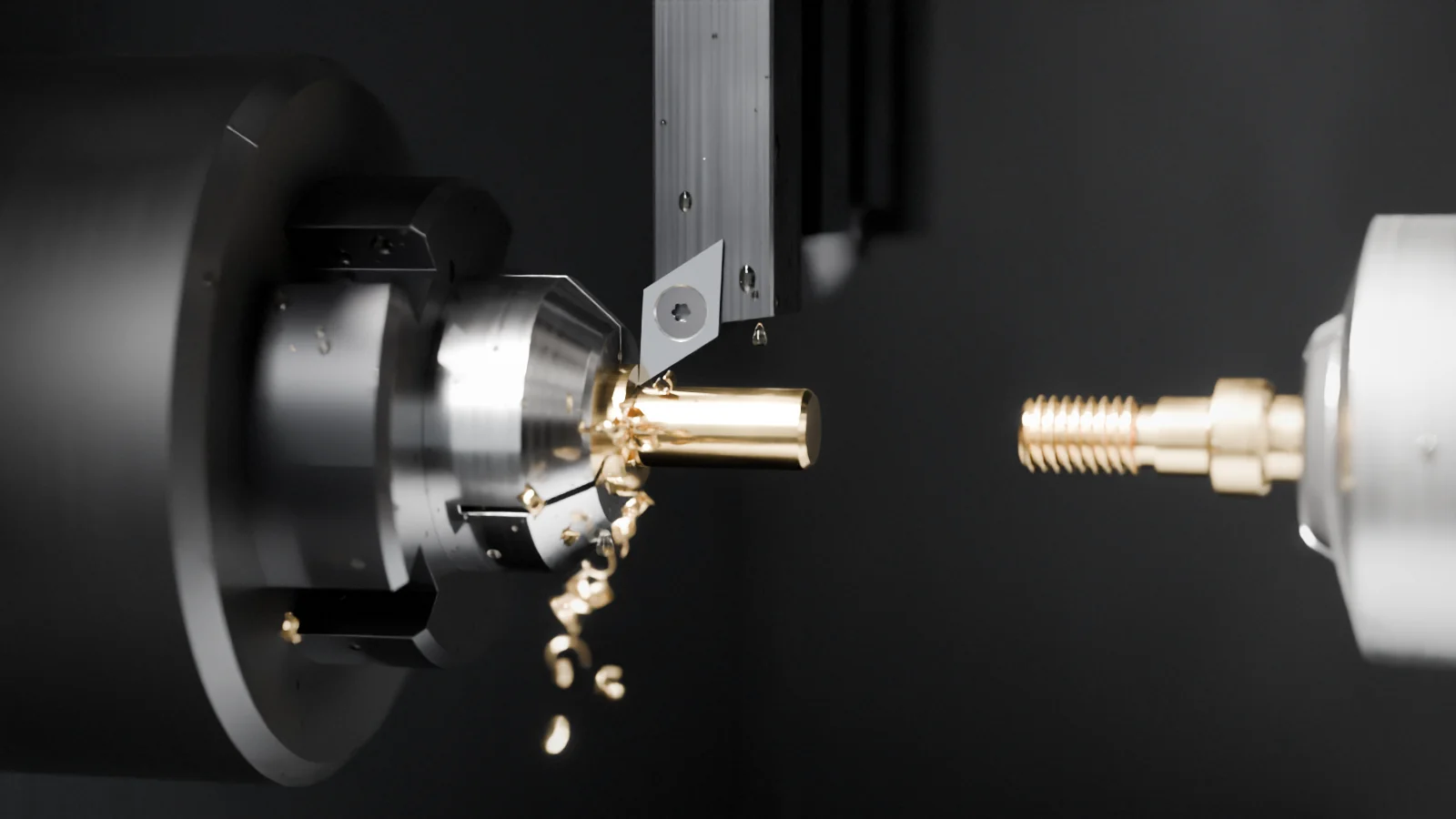
A Swiss-type lathe is a sliding-headstock automatic: the headstock holding the bar moves along the axis, and a guide bushing supports the material right next to the tool. This produces slender turned parts with a length-to-diameter ratio above about 3:1 from bar up to around 32 mm, up to 42 mm depending on the machine, finished in a single run.
It is the key turning technology for small precision mechanical components. This article explains the working principle, the difference from conventional CNC turning, the limits on diameter and length, the materials and the batch size from which the process pays off. It draws on trade press, manufacturers' documentation, the Swift and Booker handbook and data sheets from the German Copper Institute (DKI).
Swiss-type turning: how a sliding-headstock lathe works
On a Swiss-type lathe the longitudinal feed is not made by the tool but by the headstock: it clamps the bar in a collet and pushes it through a bushing past the tool. The tool sits just in front of the bushing and usually moves only radially, so cutting always takes place close to the support, whatever the part length.
The defining feature: the workpiece moves, not the tool. The bar slides out of the bushing millimetre by millimetre, the bushing itself stays in place, and the machined section projects freely into the work area. This is why very thin contours can be turned, because the cutting force never acts far from the support. The machine always works from bar stock pushed forward by a bar feeder.
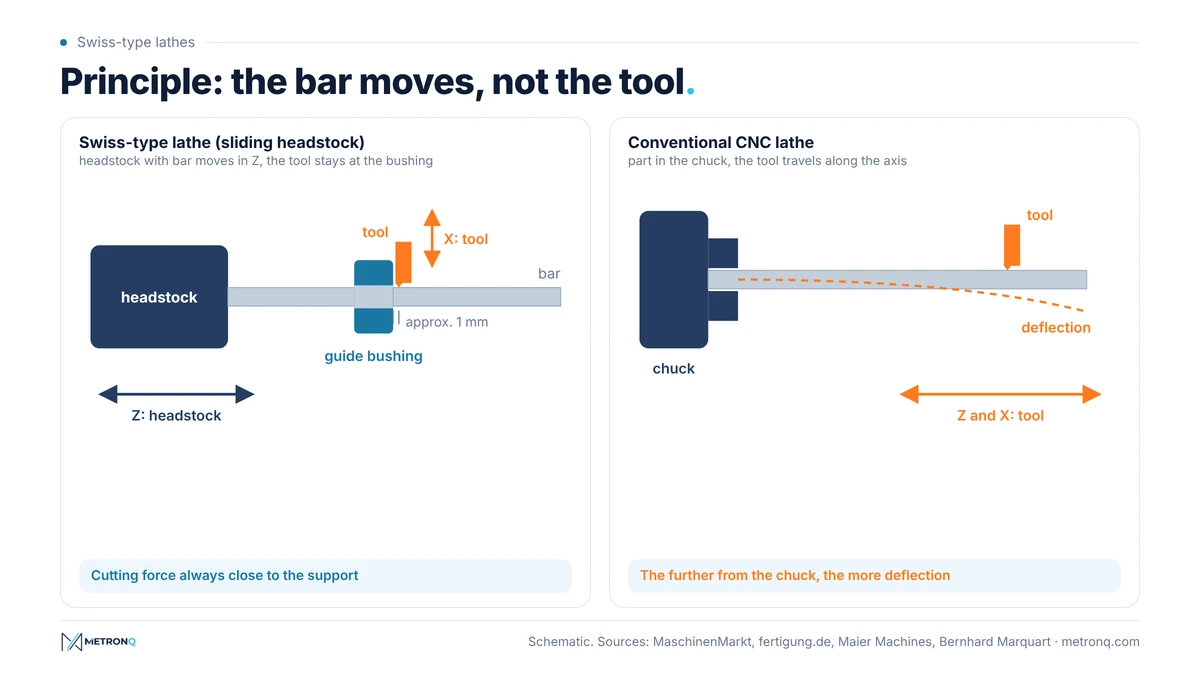
Machine builders call this the Swiss principle with a sliding headstock. There are also designs in which a tool carrier makes the longitudinal feed; the German magazine fertigung.de calls them the Offenbach principle. This article covers the widespread Swiss design used by nearly all CNC sliding-headstock lathes today.
A customer who orders turned parts only sees the result: parts that drop off the machine finished. For the shop it means turning from bar, parting off, machining the back and starting the next part without anyone stepping in. The machine runs the whole production cycle, from feeding the bar to setting down the part.
Guide bushing: support right at the cutting edge
The guide bushing is the heart of the machine. It sits in front of the headstock, holds the bar with a clearance of a few micrometres and takes up the cutting force before it can bend the workpiece. Manufacturers and job shops state that the tool usually cuts about 1 mm from the bushing face. Depending on the design, the bushing rotates with the bar or stands still.
That is why the raw material matters too. The bar must be straight and have a tight diameter tolerance. Manufacturers' documentation names ground or peeled bar; the tolerance classes quoted vary between sources, typically h6 to h9. With ordinary hot-rolled bar the bushing either binds or guides too loosely.
The second cost is the remnant. After each part the collet opens, and the headstock moves back and grips again. Because the collet holds the bar behind the guide bushing, a piece that can no longer be machined is left at the end of every bar; suppliers and job shops usually quote 100 to 200 mm. Many machines can therefore also run without a guide bushing: for short parts the scrap falls, but the benefit of the support is lost.
Where the technology comes from
The principle emerged in the 1870s in the Swiss watch industry for mass-producing small screws and arbors for movements. Jakob Schweizer is usually named as the inventor; sources give 1872 or 1880. For decades the machines were cam-controlled, and every part needed its own set of cams.
Tornos presented the first numerically controlled sliding-headstock lathe, the Elector 16, in 1978. CNC machines have dominated ever since, today for parts from about 0.5 mm to 42 mm in diameter. Their main domain is still precision mechanical parts for watchmaking, medical technology, electronics and the automotive industry.
Swiss-type or conventional CNC turning: what is the difference?
On a conventional CNC lathe a chuck or collet holds the workpiece and the tool moves along and across the axis. The further from the chuck the tool cuts, the more a slender part deflects. Conventional CNC turning of long parts therefore needs a tailstock or a steady rest.
The table summarises the differences on which the sources agree:
| Feature | Swiss-type lathe | Conventional CNC lathe |
|---|---|---|
| Longitudinal feed | headstock with bar | tool |
| Support | guide bushing right at the cutting edge | chuck, tailstock for long parts |
| Typical diameters | up to about 32 mm, some machines up to 42 mm | large diameters as well |
| Raw material | bar with tight diameter tolerance | bar, sawn blanks, forgings |
| Setup | long, often several hours | shorter |
| Strength | slender, complex parts in series | large and short parts, small batches |
A conventional lathe is more flexible: it also turns large diameters and is set up faster. It remains the better choice for one-offs and small batches of large or short parts. On a Swiss-type lathe, by contrast, every second of cycle time counts, because the machine makes thousands of identical parts one after another.
The cost difference comes from setup: a conventional lathe spreads its shorter setup over a few parts, the Swiss-type lathe only over many. Conventional turning is not worse, it is made for different batch sizes. Some machines can even be switched between short and long turning; the Index TNL20, according to the manufacturer, in a few minutes.
Day to day the difference also shows in operation. Swiss-type lathes have 7 to 13 axes and up to three slides cutting at the same time. Programming takes longer, and chips need well-thought-out solutions because the work area is tight. Almost any turner can run a conventional lathe, but a part machined on both sides often needs two setups there.
Length-to-diameter ratio and bar diameter
Geometry comes first. From a length-to-diameter ratio (L/D) of about 3:1, job shops and machine dealers consistently recommend Swiss-type turning, and above about 10:1 it is often the only stable route. According to manufacturers, short-turning lathes handle parts up to about 2.5 times the diameter in length without extra support.
The ideal part is slender and rotationally symmetric, with cross holes, flats or threads as extras. Some suppliers also run short parts with many operations on both sides on Swiss-type lathes, then often without a guide bushing. A short, thick part belongs on a chucking lathe.
The diameter itself is the next limit. Most machines are built for bar up to 20 or 32 mm, some for 38 or 42 mm. Small and medium diameters up to about 32 mm are where the process shines, and larger diameters are cheaper to turn on a chucking lathe.
A pin 2 mm in diameter and 40 mm long has a length-to-diameter ratio of 20:1. On a conventional lathe it would chatter under the tool, while a Swiss-type lathe turns it in one pass because the bushing supports every new millimetre. That is how accurate diameters can be held even on slender parts.
There are two limits, though. First, the outer contour is usually turned to size in a single pass, because guidance is lost once the bar is retracted. Second, the achievable accuracy depends on material, tool wear and temperature, not on the process alone.
Economically the machine is at its best on small diameters: for simple parts suppliers quote cycle times of a few seconds. Medium diameters also pay off as long as the part stays slender. Large diameters are the domain of the lathe.
Complete machining: sub-spindle and live tools
Complete machining means that the part leaves the machine finished. A CNC Swiss-type lathe has a sub-spindle next to the main spindle; it takes over the part and machines the back while the next part is already being made at the front. Live tools add cross drilling, milled flats, polygon turning and thread whirling.
A part with a cross hole, a flat and a thread can therefore be made in one setup. Drilling, milling and threading that would otherwise need a second machine fit into the same cycle. Complete machining on one machine saves reclamping and waiting between workstations.
The gain is not only time. Without reclamping there is no error between two setups, for example in the concentricity of front and back. Secondary operations on a second machine, such as milling or cross drilling, often disappear entirely, which cuts the cost of transport, setup and inspection.
A sub-spindle and live tools pay off when the part needs operations on both sides. A bar feeder is standard: it is what makes unattended running possible.
Advantages of Swiss-type lathes
The advantages show on complex parts in series production, and complete machining is the most important of them. Turning, drilling and milling run one after another or simultaneously on several slides, all in one program. Where a part is made in a single cycle, buffers, transport and intermediate inspections disappear.
This shortens lead time, reduces sources of error and inspection effort, and avoiding reclamping lowers the cost per part. Precision mechanical parts such as pins, shafts, contacts, nozzles or screws therefore come off the machine finished, even in large series. With a bar feeder the machine can run a whole shift without operator intervention.
These advantages have a price. Many integrated operations mean longer programming and setup, and the process needs ground bar and well-planned chip handling. Even the best machine only produces cheaply when the batch carries the setup cost.
Precision
How precise is a Swiss-type lathe? For well-controlled processes, suppliers quote tolerances of ±0.005 to ±0.01 mm or IT6 to IT7 and surface roughness down to Ra 0.4 µm. These are claims under favourable conditions, not a guarantee for every part. How IT grades translate into dimensions is shown in the article IT tolerance grades.
These values come from the stiffness of the setup: the bushing supports the material right at the cutting edge and only the workpiece moves, so the part barely deflects. Machining in one setup also keeps front and back concentric. Material, temperature and tool wear still limit tolerances, so quality control with measuring cycles is part of the series process.
The tool matters as well. According to an article in MaschinenMarkt, Swiss-type turning uses almost exclusively positive inserts, and runout and edge height matter as much as sharpness. Ra 0.4 is achievable but not automatic; which values machining delivers is described in the article surface roughness Ra and Rz.
Materials: brass, steel, aluminium and plastics
According to manufacturers, Swiss-type lathes machine free-cutting steel, stainless steel, titanium, brass, bronze, aluminium and plastics. Chip form and heat are decisive: long-chipping materials wrap around the tool and the workpiece. That is why many machines run on neat cutting oil instead of water-based coolant.
Brass on Swiss-type lathes
Brass and Swiss-type lathes have belonged together since the days of watch screws. CuZn39Pb3 (CW614N) is the reference material for machinability: the DKI gives it a machinability index of 100 and describes short, broken needle chips. The chips do not clog the work area, which matters greatly for unattended running. Typical parts from this alloy include connector pins, screws and watch parts.
Lead-free grades such as CuZn21Si3P (CW724R) have an index of about 65 to 90 according to the literature and put more load on the tools. It is therefore worth agreeing the brass grade with the customer early, because it changes cutting data and tool costs.
Plastics
Plastics such as POM, PA or PEEK can also be turned on Swiss-type lathes, but different rules apply. In its machining guidelines Ensinger points to thermal expansion that is many times greater and states that plastics need wider manufacturing tolerances than metals. Parts with accurate dimensions require stress-relieved, annealed stock.
Heat should leave with the chip, and the tools must be sharp. For PTFE Ensinger recommends defining dimensions at about 23 °C. Plastics are softer than metals, so the guide bushing also helps here by keeping thin parts from deflecting. For tight tolerances it is worth stating measurement at a defined temperature on the drawing. Suppliers of plastic parts also recommend Swiss-type lathes for thin, slender parts.
When to choose a Swiss-type lathe: batch size and cost
The sources name three conditions: a length-to-diameter ratio above about 3:1, a diameter up to about 32 mm and a batch that carries the setup cost. If one of them is missing, a chucking lathe is usually the better choice. Usually the third decides, because geometry is visible on the drawing at once.
Batch size matters most, because setup time is at the core of the calculation. Swift and Booker write about automatic lathes that changeover and setup can take many hours, and give economical quantities for automatic machines from 1,000 parts. Job shops quote thresholds from a few hundred to over 10,000 parts.
The machine cost per part can be estimated like this:
where:
- - machine cost per part [EUR],
- - setup time [h],
- - machine hourly rate [EUR/h],
- - number of parts in the order,
- - cycle time per part [h].
Example (sample values): setup 3 h, machine rate 90 EUR/h, cycle time 60 s. Setup costs 270 EUR and the cycle 1.50 EUR per part. At 50 parts, 5.40 EUR of setup is added, 6.90 EUR in total, and setup makes up 78% of the machine cost. At 500 parts it is 2.04 EUR (26%), at 5,000 parts 1.55 EUR (3.5%).
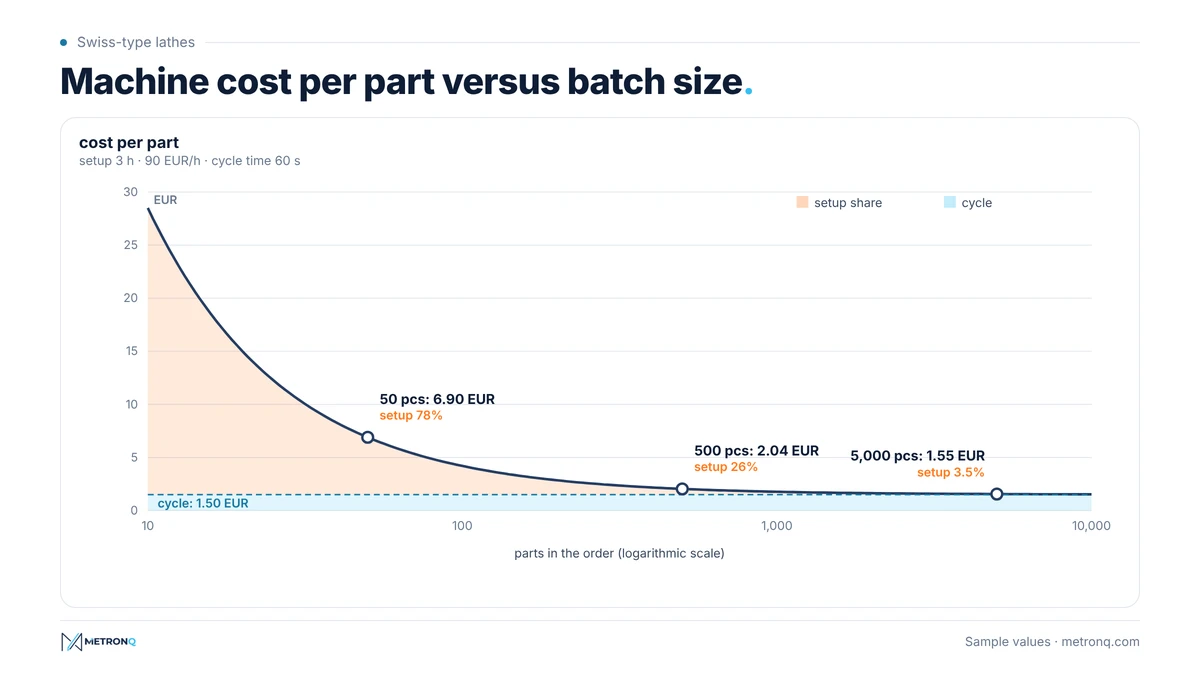
The calculation shows why job shops recommend Swiss-type turning from medium series upwards and prefer conventional lathes for small batches. At a few dozen parts, setup is most of the price; in medium series it drops to a small remainder. More on setup in the price is in the article the most expensive minute in CNC machining.
If a Swiss-type lathe is chosen despite a small batch, the customer pays mainly for the setup. If it is chosen because the geometry leaves no alternative, the setup share should be stated openly in the quote. For repeat orders a stored program and tooling shorten the next setup, and saved secondary operations belong in the calculation too.
In MetronQ, Swiss-type lathes are part of the machine catalogue. For each machine you set the hourly rate, setup effort and minimum batch size; below the minimum batch the machine is left out of the quote, and setup is charged once per order. How this works is shown on the page machines and quote calibration.
The difference from turning on an ordinary lathe is covered in the article longitudinal turning, and how to break a quote down into its components in CNC machining quotes and costs.
Frequently asked questions about Swiss-type lathes
From what batch size does a Swiss-type lathe pay off?
There is no fixed limit. Swift and Booker give economical quantities for automatic lathes from 1,000 parts, and job shops quote thresholds from a few hundred to over 10,000 parts. The calculation is usually favourable from medium series upwards. What decides is whether the batch carries a setup that often takes several hours.
What diameters can be turned on a Swiss-type lathe?
Most Swiss-type lathes are built for bar up to 20 or 32 mm, some for 38 or 42 mm, and the smallest parts start at about 0.5 mm. Larger diameters are usually cheaper to turn on a chucking lathe. Besides the diameter, the length-to-diameter ratio counts, and from about 3:1 it speaks for a Swiss-type lathe.
How precise is a Swiss-type lathe?
For well-controlled processes, suppliers quote tolerances of ±0.005 to ±0.01 mm or IT6 to IT7 and surface roughness down to Ra 0.4 µm. These are values under favourable conditions. Material, length-to-diameter ratio, temperature and tool wear decide what can be achieved reliably and economically on a specific part.
When to choose a Swiss-type lathe and when conventional CNC turning?
A Swiss-type lathe suits slender parts above about 3:1, diameters up to about 32 mm and complex parts that can be finished in one setup. The batch must carry the setup. Conventional CNC turning with a chuck is better for large diameters, short parts and one-offs, because the lathe is set up faster.
Why does a Swiss-type lathe need ground bar stock?
The guide bushing holds the bar with a clearance of a few micrometres. If the diameter varies too much, the bar binds or is guided too loosely, and accuracy is lost. That is why manufacturers' documentation names straight, ground or peeled bar in tolerance classes typically quoted from h6 to h9.
Can plastics be turned on a Swiss-type lathe?
Yes, POM, PA and PEEK are often turned into thin pins and bushes on Swiss-type lathes. Plastics expand with heat many times more than metal, so they need sharp tools, stress-relieved stock and measurement at a defined temperature. The achievable tolerances are usually wider than for metals.
Sources
- 1.K. G. Swift, J. D. Booker, Manufacturing Process Selection Handbook, Butterworth-Heinemann 2013, rozdz. 6.1 Turning and Boring, https://shop.elsevier.com/books/manufacturing-process-selection-handbook/swift/978-0-08-099360-7
- 2.MaschinenMarkt (M. Böhm, 2021), "Langdrehen: Aus der Nische zur globalen Massenfertigung", https://www.maschinenmarkt.ch/langdrehen-aus-der-nische-zur-globalen-massenfertigung-a-1081084/
- 3.MaschinenMarkt (A. Richter, 2020), "Drehen mit beweglichem Spindelstock", https://www.maschinenmarkt.ch/drehen-mit-beweglichem-spindelstock-a-84506a53c06cf47ad43dcd07898f7858/
- 4.fertigung.de (W. Frick, 2019), "Mit Langdrehautomaten schlanke Werkstücke bearbeiten", https://www.fertigung.de/technologien-innovation/mit-langdrehautomaten-schlanke-werkstuecke-bearbeiten/2343729
- 5.Maier Machines, "Technik des Langdrehens", https://maier-machines.de/anwendungstechnik/technik-des-langdrehens/
- 6.Bernhard Marquart, "Das Swiss-Type-Prinzip", https://www.bernhard-marquart.de/wissen/swiss-type-prinzip
- 7.Wikipedia, "Tornos AG", https://en.wikipedia.org/wiki/Tornos_AG
- 8.IsoCNC, "Swiss Machining: How Swiss-Type Turning Works", https://isocnc.com/resources/swiss-machining/
- 9.Wevolver, "What Is Swiss Machining? Swiss-Type CNC Lathes Explained", https://www.wevolver.com/article/what-is-swiss-machining-swiss-type-cnc-lathes-explained
- 10.Van Makina, "What Is a Swiss-Type Lathe?", https://vanmakina.com/en/what-is-a-swiss-type-lathe/
- 11.Yonglihao Machinery, "Guide Bushing vs. Non-Guide Bushing Swiss Machining", https://chinamachiningsolutions.com/guide-bushing-vs-non-guide-bushing-swiss-machining/
- 12.Bechtle PLM, "Langdrehen oder Kurzdrehen" (2025), https://www.bechtle-plm.at/wissen/blog/langdrehen-kurzdrehen/
- 13.Haller-Jauch, "Langdrehteile", https://www.haller-jauch.de/drehteile/langdrehteile/
- 14.Geissler Präzisionsdrehteile, "Langdrehteile", https://www.geissler-drehteile.de/langdrehteile
- 15.Strobel Industry, "Langdrehteile", https://strobel-industry.de/langdrehteile/
- 16.Strobel Industry, "Kunststoff-Drehteile POM & PEEK", https://strobel-industry.de/kunststoff-drehteile/
- 17.VEGU Präzisionsdrehteile, "Langdreher Lohnfertigung", https://vegu.at/langdreher-lohnfertigung/
- 18.Präzisionstechnik Dresden, "Long turning", https://pt-dresden.de/en/long-turning
- 19.Deutsches Kupferinstitut, Werkstoff-Datenblatt CuZn39Pb3 (CW614N), https://kupfer.de/wp-content/uploads/2019/11/CuZn39Pb3-1.pdf
- 20.Müller-Welte, "Zerspanbarkeit von Messing: Legierungen im Vergleich" (2026), https://www.mueller-welte.de/blog/zerspanbarkeit-messing-vergleich
- 21.Ensinger, "Zerspanungsrichtlinien" für technische Kunststoffe, https://docs.rs-online.com/7459/0900766b80329b0c.pdf
- 22.Ensinger, "Technische Kunststoffe: Das Handbuch", https://plasticker.de/docs/news/Ensinger-Handbuch_01.pdf
Read next
Quote your own part
Upload a 3D model or a drawing and see the price from the MetronQ engine. No account.
Quote a part in the demoCreate a free account