Laser Power, Maximum Thickness and Cutting Speed
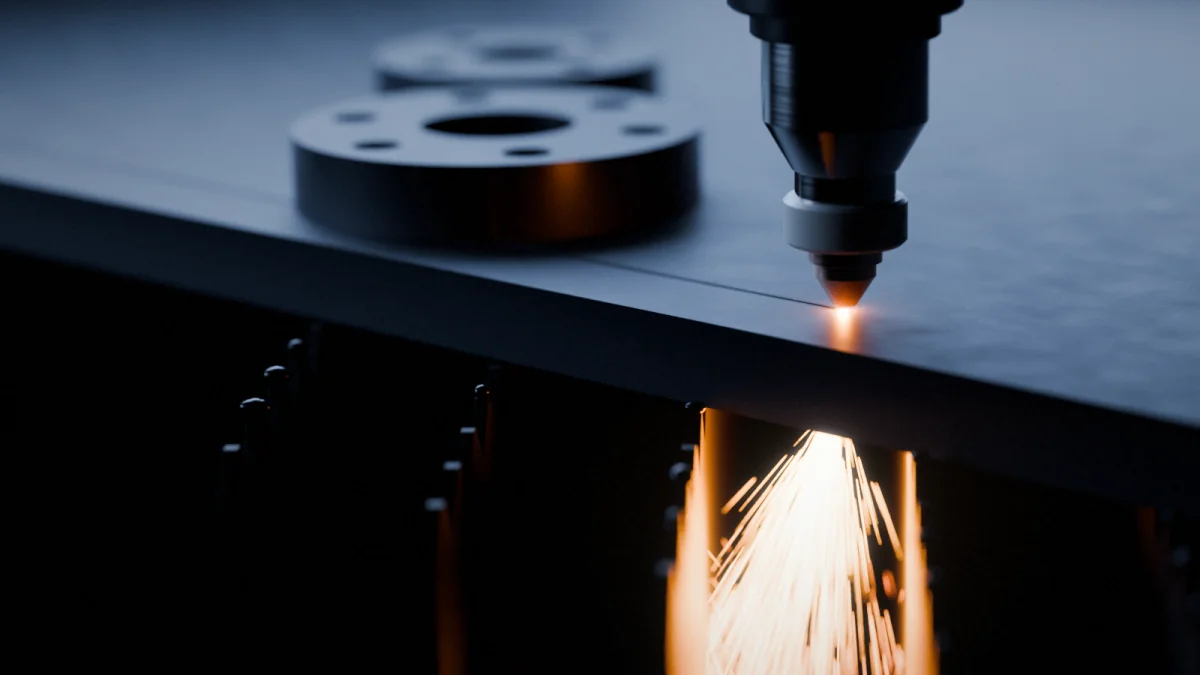
Laser power mainly decides how fast and with what quality a sheet of a given thickness can be cut, and only secondarily how thick a sheet the machine can cut at all. The catalogue maximum thickness rises with power in steps and soon levels off, while cutting speed falls with thickness faster than proportionally. For costing, what counts is the real cutting thickness, not the nominal one.
This overview covers laser cutting of sheet metal and is based on data from Trumpf, Bystronic and Amada, research by IPG Photonics, the LIA guide and ISO 9013. At the end, an example shows what the choice of assist gas costs on thick plate.
Laser cutting: how power affects thickness and speed
Laser cutting melts metal with a focused beam and blows it out of the kerf with a gas jet. More power makes it possible to cut thicker material, but above all it speeds up cutting of medium-thickness sheet. LIA (Laser Institute of America) describes this with cutting efficiency, speed times thickness divided by power:
where:
- - cutting efficiency [mm²/kJ],
- - cutting speed [mm/s],
- - material thickness [mm],
- - laser power [kW].
In the LIA example, 3 mm stainless steel cut at 95 mm/s with 5 kW gives = 3 · 95 / 5 = 57 mm²/kJ. If were constant, a sheet twice as thick would mean half the speed. According to LIA, however, efficiency drops with thickness, so speed falls faster, and the same cutting output on thick plate needs disproportionately more power.
In recent years laser cutting has moved from CO2 lasers to fiber lasers with a wavelength of about 1 µm, which changed how lasers are used in sheet metal work. Fiber lasers handle reflective metals such as copper and brass better.
Laser cutting processes are grouped by assist gas. With mild steel, oxygen adds energy from the combustion reaction, nitrogen gives an oxide-free edge, and air is a cheaper alternative. Each process reacts differently to more power, so the choice between them is a decision about cost, quality and speed at the same time.
Maximum cutting thickness: nominal versus real thickness
The maximum cutting thickness in a catalogue is a nominal value that the machine cuts under good conditions. Amada notes that it depends on material quality and ambient conditions, and Bystronic that it applies to well-maintained machines and sheet that meets the specification. The real cutting thickness in production is usually lower and depends on the required edge.
| Material | Maximum thickness, Trumpf 12 kW (TruLaser 3030 fiber) [mm] | Bystronic ByCut 12 kW [mm] | Amada ENSIS-3015AJ 12 kW [mm] |
|---|---|---|---|
| structural steel | 30 (35 with thick-sheet package) | 25 (30 with BeamShaper) | 25 |
| stainless steel | 40 (50 with thick-sheet package) | 30 | 25 |
According to its catalogue, the Trumpf 12 kW machine cuts structural steel up to 30 mm, and the 24 kW version of the same series up to 40 mm (60 mm with the package). The Amada ENSIS-3015AJ fiber laser cuts mild steel up to 25 mm at 12 kW, the same as the 6 kW version, so the extra power goes into speed and nitrogen cutting. Trumpf's thick-sheet packages and Bystronic's BeamShaper option are meant for thicker material, and catalogue limits differ between manufacturers even at the same power.
Bystronic's data for the ByCut series show the levelling off most clearly. At 3 kW the machine cuts steel up to 20 mm, and from 6 to 30 kW the maximum is 25 mm (30 mm with BeamShaper). For stainless steel and aluminium the maximum rises from 12 mm at 3 kW to 30 mm at 6-12 kW and 40 mm from 15 kW.
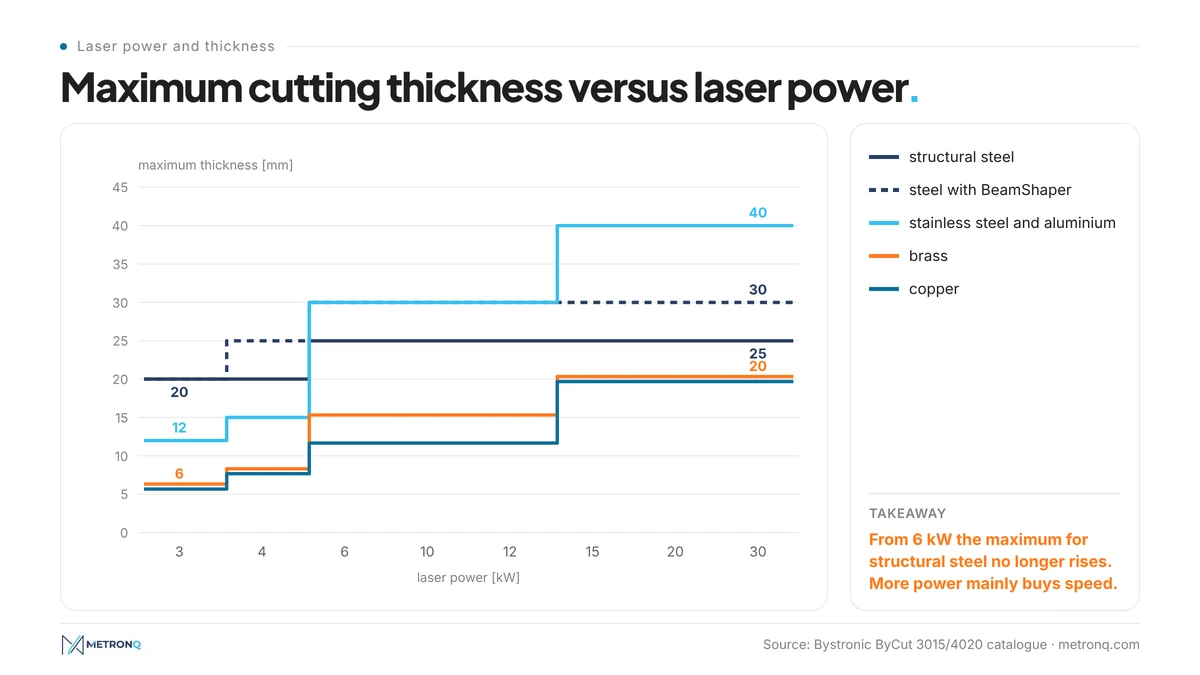
The chart shows that the thickness range grows in steps. Instead of asking how thick a steel plate the machine can cut, it is better to ask how thick a plate it can cut at a speed and quality that pay off. The catalogue maximum is an upper limit, not an operating point.
For comparison, the handbook by Swift and Booker (2013 edition), which mainly describes CO2 lasers, gives: mild steel 25 mm, stainless steel 13 mm, aluminium 10 mm. Since then the range for stainless steel has grown from 13 to 40 mm and more, and for aluminium from 10 to 40 mm.
How thick aluminium, copper and brass can be cut depends on how strongly the metal reflects the beam and how quickly it conducts heat away. Aluminium can be cut about as thick as structural steel, while copper and brass end at a dozen or so millimetres in the catalogues.
| Material, maximum thickness [mm] | Trumpf 3030 fiber 12 kW | Bystronic ByCut 12 kW | Amada ENSIS-3015AJ 12 kW |
|---|---|---|---|
| Aluminium | 30 (40 with package) | 30 | 25 |
| Copper | 12.7 | 12 | 12 |
| Brass | 12.7 | 15 | 18 |
As with stainless steel, aluminium is usually cut with nitrogen. The maximum thickness for aluminium rises clearly with power: Bystronic gives 12 mm at 3 kW and 40 mm from 15 kW. Cutting aluminium close to the catalogue limit is slow, however, because aluminium conducts heat away very well.
For copper the maximum thickness rises more slowly with power: Trumpf gives 10 mm at 6 kW and 12.7 mm at 12 kW for the TruLaser 3030 fiber, and 16 mm at 12 kW for the TruLaser 5030 fiber. Cutting copper became practical with fiber lasers, because copper strongly reflects CO2 radiation. Bystronic gives 12 mm at 6-12 kW and 20 mm from 15 kW, so copper thicker than a dozen or so millimetres needs high power.
For brass the catalogues give 12.7-18 mm at 12 kW, which at Bystronic and Amada is more than for copper. The differences at the same power show that the catalogue value for brass is a property of the specific machine. Tables for laser cutting of sheet metal do not cover acrylic, which is a job for different machines.
Laser cutting speed for different material thicknesses
Cutting speed falls as thickness increases, and power shifts the curve upwards. The largest gains are on medium thicknesses: according to IPG, the speed of air cutting 12 mm carbon steel rose by 280% when moving from 15 to 40 kW, and for 20 mm by 420% in the same comparison. Thickness, speed and quality must be assessed together.
IPG notes that a laser cutting speed below 2 m/min in continuous-wave mode indicates too little power for optimal quality. High speed is not a goal in itself, but speed that is too low rules out a high-quality cut.
The assist gas changes the relationship between power and speed. In oxygen cutting of mild steel, the thickness up to which a high-quality cut with a glossy edge is possible moved, according to IPG, from 6-8 mm at 4 kW to 30 mm at 15 kW. Oxygen cuts thick steel, but slowly: for 16 mm the speed stays at about 2 m/min whether the source has 10 or 30 kW.
Air cutting behaves the other way round: at 30 kW the laser cuts 16 mm steel at more than 9 m/min, 4.5 times faster than with oxygen. IPG cut carbon steel dross-free with air at 20 mm with 20 kW, 30 mm with 30 kW and 40 mm with 40 kW. Thickness, speed and gas pressure go together: at 15 kW, 20 mm steel needed air above 16 bar, while from 20 kW 10-12 bar was enough.
Stainless steel is cut with nitrogen so that the edge stays oxide-free. There is no combustion reaction to help, so power translates directly into time: according to IPG, a 30 kW laser cuts a typical 16 mm stainless part in half the cycle time of a 15 kW laser. Nitrogen is also used on structural steel: Amada states that the 12 kW version cuts steel with nitrogen up to 15 mm.
Laser cutting parameters and edge quality
Besides power and speed, laser cutting parameters include gas type and pressure, nozzle diameter, focal position and spot diameter. The manufacturer stores them in the machine's technology tables. These parameters determine the kerf, edge quality and piercing time, and therefore also the cost of the part.
Amada states that the 12 kW version pierces 25 mm steel in about 1 s. On parts with many holes, piercing time can be comparable to contour cutting time, so part geometry affects cost as much as thickness does.
According to Wikipedia, the kerf can be as narrow as 0.10 mm. In Hashemzadeh's tests (2014) the kerf with oxygen was 0.4-0.6 mm and with nitrogen 0.24-0.37 mm. According to LIA, a wider kerf requires more energy, and Bystronic describes BeamShaper, which deliberately widens it in thick steel.
Edge quality after thermal cutting is classified by ISO 9013:2017 using the perpendicularity or angularity tolerance (u) and the mean height of the profile (Rz5). The standard covers laser cutting from 0.5 to 32 mm. A high-quality cut on thick plate needs a power reserve, and cut quality is best checked on a sample from the actual material batch.
Cutting thick plate: plasma cutting and oxyfuel cutting
Laser cutting of thick plate is possible up to several tens of millimetres, but on heavy sections it competes with plasma and oxyfuel cutting. ISO 9013 covers plasma cutting from 0.5 to 150 mm and oxyfuel cutting from 3 to 300 mm. Cutting thicker material with a laser pays off when accuracy and a narrow kerf matter.
Oxyfuel cutting works only on carbon and low-alloy steel because it relies on burning iron. Plasma cutting works on electrically conductive metals, including stainless steel and aluminium. IPG compared a 40 kW laser with 300 A plasma: on mild steel from 12 to 30 mm the laser was 3-5 times faster. Thick steel beyond the laser range is cut with plasma or an oxyfuel torch. How laser, plasma and waterjet compare on cost is shown in Laser, Plasma or Waterjet: Methods and Costs.
Tube and profile cutting: wall thickness
Tubes and profiles are cut on separate machines, for example the Trumpf TruLaser Tube. Wall thickness on them is lower than flat sheet thickness: the Trumpf TruLaser Tube 7000 fiber with a 12 kW laser cuts structural steel up to 20 mm, stainless steel and aluminium up to 15 mm, and copper and brass up to 5 mm.
The machine takes round tubes up to 273 mm in diameter. Its data sheet gives a separate table for tubes: material, maximum wall thickness and laser power.
Choosing a laser cutter: material, laser power, maximum thickness
A machine or a cutting service is chosen in this order: material, laser power, maximum thickness. First comes the question of which materials and thicknesses dominate the orders, then the power at which those thicknesses can be cut at a profitable speed, and only last the catalogue maximum thickness as a reserve.
For steel, a 6 kW fiber laser cutter cuts up to 25 mm according to Bystronic, the same as a 30 kW one; the difference lies in speed and gas. According to LIA, fiber lasers are more efficient on thin sheet and CO2 lasers on thick plate. High-power fiber laser cutters are now taking over thick steel jobs that used to go to plasma.
Industrial laser applications include cutting sheet, tubes and profiles as well as marking and welding. When ordering laser cutting of metal, what counts is concrete data: machine power, real cutting thickness for the given material and edge quality. A modern machine park in an offer means little without a thickness table.
When choosing a supplier, it helps to state the required edge class according to ISO 9013 on the drawing, so that quotes can be compared. Lasers have long been the standard for thin sheet, and when comparing suppliers it is worth asking which machine (fiber or CO2) and what power they use.
Laser cutting in costing: an example
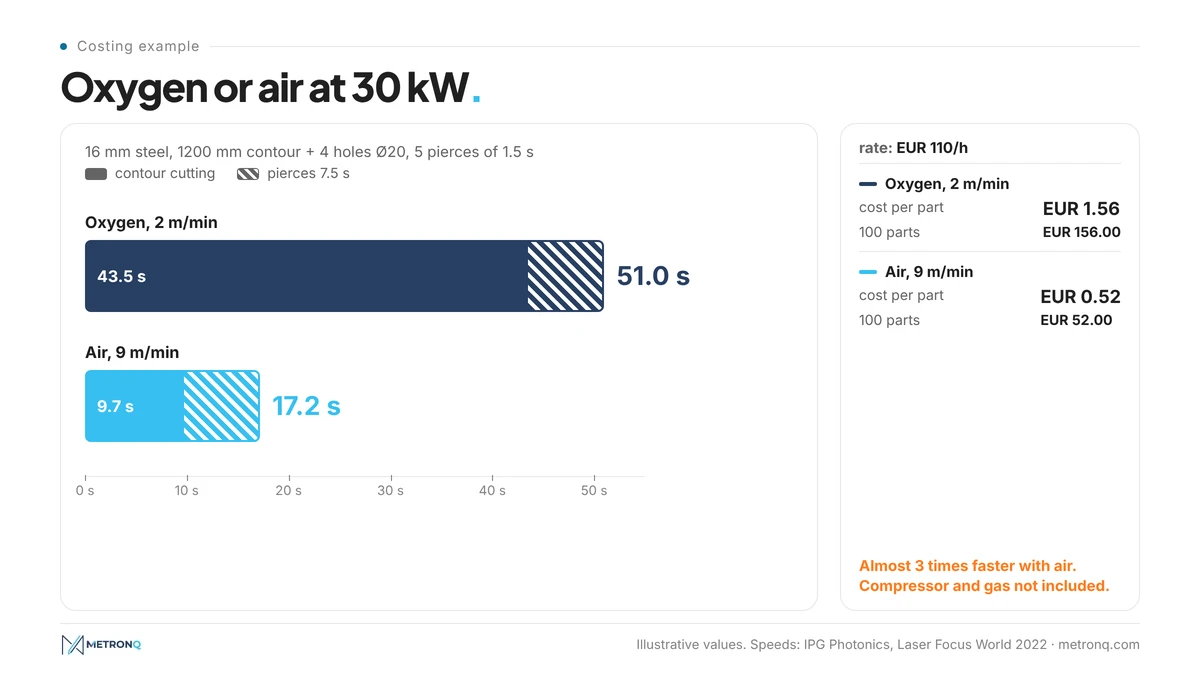
Laser cutting time is the contour length divided by the speed plus piercing time. Example (illustrative values): a 16 mm mild steel plate, 1200 mm outer contour and 4 holes of Ø20, so 1451.33 mm of cut and 5 pierces of 1.5 s. Speeds are taken from IPG's results at 30 kW: oxygen about 2 m/min, air 9 m/min.
| Illustrative values | Oxygen, 2 m/min | Air, 9 m/min |
|---|---|---|
| Contour cutting time | 43.5 s | 9.7 s |
| Pierces, 5 · 1.5 s | 7.5 s | 7.5 s |
| Time per part | 51.0 s | 17.2 s |
| Cost at EUR 110/h | EUR 1.56 | EUR 0.52 |
| 100 parts | EUR 156.00 | EUR 52.00 |
With air, the part is made almost 3 times faster, but the cost does not include the compressor or the gas. On thicker material and at lower power the advantage of air shrinks, because according to IPG a clean edge then needs higher pressure. Part geometry changes the result: many small holes increase the share of piercing, and sharp corners require slowing down.
Part geometry therefore determines how long it takes to cut sheets of the same thickness. The same timing principles apply to machining, as described in the article on how a machining quote is built.
Metalworking after cutting: CNC machining
Metalworking often does not end with cutting. After laser cutting, a thick plate part goes to a milling machine when it needs threads, fitted holes, chamfers or faces with a tolerance that thermal cutting cannot deliver. CNC machining is needed wherever the perpendicularity deviation of the edge (u according to ISO 9013) exceeds the drawing requirement.
CNC machining then starts from a blank cut with stock allowance, and the geometry after cutting defines the datums. Series production of thick plate parts is a typical case in which laser cutting and CNC machining are planned together. How accuracy affects cost is covered in the article on tolerances vs CNC machining cost, and the process itself in the article on CNC milling.
MetronQ does not price laser cutting, but it does price CNC machining of the cut part: the shop sees in the shop panel a price breakdown by operation, such as milling, drilling and tapping, calculated on its own machines and rates. Setup time is charged once per order, as described in the article on the most expensive minute.
Frequently asked questions about laser power and cutting thickness
What is the maximum laser cutting thickness and what determines how thick a steel plate a machine can cut?
According to catalogues, a 12 kW laser cuts carbon steel up to 25-30 mm, and with thick-sheet packages up to 35 mm (Trumpf) or 30 mm (Bystronic with BeamShaper). That is the nominal thickness. The real cutting thickness depends on material quality, gas and the required edge, so in production it is usually lower.
How does laser cutting speed change with material thickness and what does cutting speed depend on?
Speed falls with thickness faster than proportionally, because according to LIA cutting efficiency decreases with thickness. Higher power raises speed most on medium thicknesses: IPG reports a 280% increase for 12 mm steel cut with air when moving from 15 to 40 kW. Thickness, speed and gas are chosen together.
What does edge quality depend on and how does material quality affect cutting capability?
Edge quality depends on speed, gas pressure, nozzle diameter and power reserve. Cutting capability also depends on material quality: Amada and Bystronic state that catalogue thicknesses apply to sheet that meets the specification. The edge is assessed according to ISO 9013 by the perpendicularity tolerance u and the roughness Rz5.
How does cutting carbon steel with oxygen differ from cutting with air?
Oxygen cutting of steel uses the combustion reaction, so it cuts thick material with less power, but speed stays at about 2 m/min. At high power, air cuts much faster: according to IPG, 16 mm steel at 30 kW is cut at more than 9 m/min, 4.5 times faster than with oxygen.
How thick can aluminium, copper and brass be laser cut?
At 12 kW the catalogues give 25-30 mm for aluminium (Trumpf with package 40 mm), 12-16 mm for copper and 12.7-18 mm for brass. Aluminium therefore reaches the thickest sections, while copper is the most difficult because it strongly reflects the beam. Exact limits depend on the specific machine.
What wall thickness is possible when laser cutting tubes?
Wall thickness is lower than sheet thickness on flatbed machines. The Trumpf TruLaser Tube 7000 fiber with a 12 kW laser cuts walls of structural steel up to 20 mm, of stainless steel and aluminium up to 15 mm, and of copper and brass up to 5 mm. The 6 kW version cuts structural steel up to 14 mm.
When is CNC machining needed after laser cutting?
CNC machining is needed when the part requires threads, fitted holes, chamfers or faces with a tolerance that thermal cutting cannot deliver. The edge after laser cutting has a perpendicularity deviation according to ISO 9013, so the cut part is then treated as a blank with stock allowance for milling.
Sources
- 1.TRUMPF, "TruLaser 3030 fiber, 3040 fiber, 3060 fiber", technical data (maximum sheet thickness by laser power), https://www.trumpf.com/en_GB/products/machines-systems/2d-laser-cutting-machines/trulaser-3030-fiber-3040-fiber-3060-fiber/
- 2.TRUMPF, "TruLaser 5030 fiber, 5040 fiber, 5060 fiber", technical data, https://www.trumpf.com/en_SG/products/machines-systems/2d-laser-cutting-machines/trulaser-5030-fiber-5040-fiber-5060-fiber/
- 3.TRUMPF, "TruLaser Tube 7000 fiber", technical data (wall thickness, tube diameter), https://www.trumpf.com/en_GB/products/machines-systems/laser-tube-cutting-machines/trulaser-tube-7000-fiber
- 4.Bystronic, "ByCut 3015 / 4020" brochure, technical data (maximum material thickness 3-30 kW, BeamShaper), https://www.bystronic.com/int/en/l/lasercuttingmachine-bycut
- 5.AMADA, "ENSIS-3015AJ / ENSIS-4020AJ" brochure (2021) and press release "AMADA ENSIS-AJ now with 12 kW power", https://www.amada.eu/nl-nl/meer/media-pers-prijzen/persberichten/2021/amada-ensis-aj-now-with-12-kw-power/
- 6.R. Sarrafi, J. Jia, J. Zhang, M. Mendes (IPG Photonics), "Advances in cutting with ultrahigh-power fiber lasers", Laser Focus World, 20.09.2022, https://www.laserfocusworld.com/laser-processing/article/14282662/advances-in-cutting-with-ultrahigh-power-fiber-lasers
- 7.Laser Institute of America (LIA), "Guide to High Power Laser Cutting" (cutting efficiency, kerf width, fiber vs CO2)
- 8.ISO 9013:2017, Thermal cutting - Classification of thermal cuts - Geometrical product specification and quality tolerances, https://www.iso.org/standard/60321.html
- 9.K. G. Swift, J. D. Booker, "Manufacturing Process Selection Handbook", Butterworth-Heinemann, 2013 (laser beam machining)
- 10.M. Hashemzadeh, "Investigation of laser cutting of mild steel" (PhD thesis), University of Nottingham, 2014
- 11.P. Wandera, V. Kujanpää, A. Salminen, "Laser power requirements for cutting of thick-section steel and effects of processing parameters on mild steel cut quality", Proc. IMechE Part B, 2011
- 12.Wikipedia, "Laser cutting", https://en.wikipedia.org/wiki/Laser_cutting
Read next
Automatic CNC machining quotes
Priced from the 3D model or the drawing, on your machines and your rates. You just approve it. 8 free quotes to start and 1 every month, no card.
Create a free account