Laser, Plasma or Waterjet: Methods and Costs
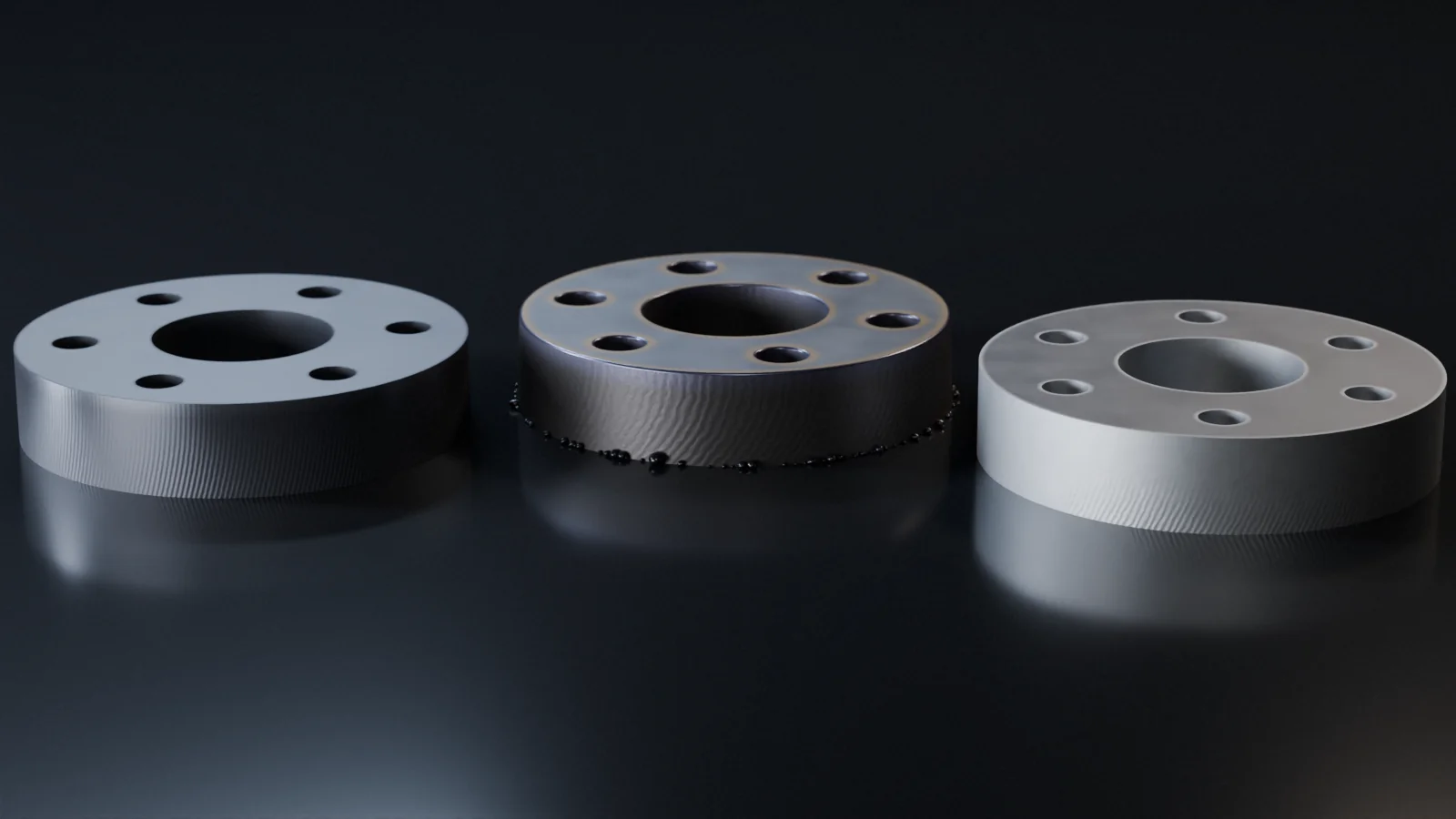
Laser, plasma and waterjet cut metal in three different ways: with focused light, with an electric arc and with water under very high pressure. The laser cuts thin and medium sheet quickly and with the narrowest kerf, plasma is economical on thick steel, and the waterjet cuts almost any material without heat, but slowly. Which method costs least depends on material, thickness and quantity.
This comparison is based on data from Trumpf, Hypertherm, Kjellberg, OMAX and IPG Photonics, on ISO 9013 and on Open University material. Manufacturer data can be one-sided, so we give the source for every figure.
Cutting methods at a glance
The three methods differ in principle, thickness range and materials. Laser and plasma are thermal cutting processes, while the waterjet removes material by erosion. Hypertherm assigns the laser mainly to thin sheet and tight tolerances, plasma to the 6-80 mm range and the waterjet to thick or very varied materials.
| Feature | Laser | Plasma | Waterjet |
|---|---|---|---|
| Thickness (Hypertherm) | usually up to 6 mm, sometimes up to 30 mm | up to 80 mm | up to 305 mm |
| Materials | many; CO₂ laser also plastics and wood | conductive metals only | nearly anything |
| Kerf | under 0.5 mm (Trumpf) | 1-4 mm (Trumpf) | from 0.38 mm depending on nozzle (OMAX) |
| Heat-affected zone | small | larger | none |
| Rusty or painted sheet | with limitations | yes | yes |
| Investment (Hypertherm ranking) | highest | medium | medium to high |
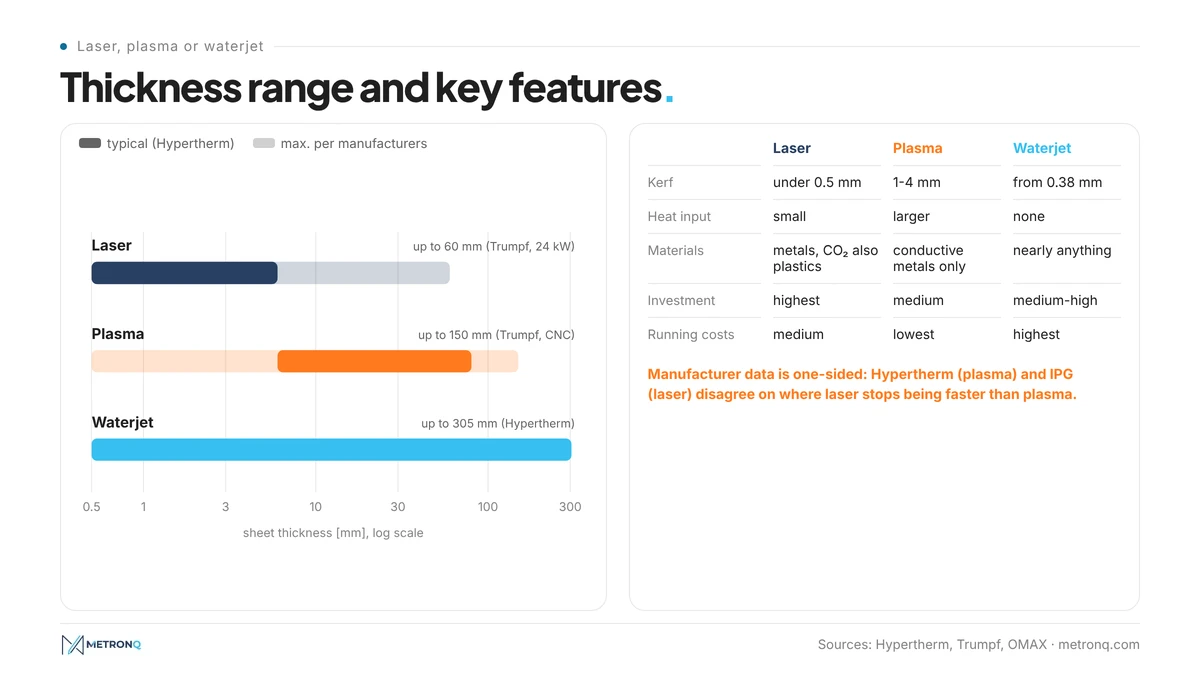
The table reflects a plasma manufacturer's view. Trumpf gives 0.5 to over 30 mm for the laser, and a 24 kW Trumpf laser with a thick-sheet package cuts structural steel up to 60 mm, as described in our article on laser power, sheet thickness and cutting speed. The method should therefore be chosen by the actual requirements, and a shop with several technologies can route each part to the right one.
| Requirement | Suitable method | Reason according to source |
|---|---|---|
| Highest precision | laser, waterjet | fine beam, kerf under 0.5 mm (Trumpf) |
| Highest speed | laser on thin sheet, plasma on thick steel | Hypertherm, IPG Photonics |
| Lowest cost on thick steel | plasma | low investment (Hypertherm) |
| Complex contours, tight radii, sharp corners | laser, waterjet | plasma: fine contours not possible (Trumpf) |
| Small holes and micro profiles | laser | focus under 0.32 mm, kerf from 0.10 mm (Wikipedia) |
| No thermal distortion | waterjet | no heat-affected zone (OMAX) |
| Dross-free, burr-free edges | laser with nitrogen or air | dross-free up to 40 mm at 40 kW (IPG) |
| Minimal material waste | laser, waterjet | narrow kerf, tight nesting |
| Rough edges acceptable | plasma, oxyfuel | lower cost |
What is laser cutting and how does it work?
In laser cutting, a focused beam melts the material and a gas jet blows it out of the kerf. With oxygen, burning iron adds energy. According to Trumpf, the laser cuts sheet from 0.5 mm to over 30 mm with a kerf under 0.5 mm, so it is the method for the most precise cuts.
The laser is more precise than plasma because, according to Wikipedia, the beam is focused to under 0.32 mm and kerfs as narrow as 0.10 mm are possible. Trumpf points to low heat input, little burr and hardly any rework. For complex contours, tight radii and sharp corners, the laser is the first choice alongside the waterjet.
The assist gas determines the result. Nitrogen gives oxide-free edges on stainless steel and aluminium, while oxygen allows thick structural steel to be cut. IPG Photonics cut 16 mm steel at 30 kW with compressed air at more than 9 m/min and with oxygen at about 2 m/min, and achieved dross-free air cuts up to 40 mm at 40 kW. According to Wikipedia, a fiber laser converts 20-30% of electrical energy into light, a CO₂ laser only 5-10%.
Laser cutters: fiber, CO₂ and Nd:YAG
Modern laser cutters mostly use fiber lasers, which according to Wikipedia have a focus up to 100 times smaller than CO₂ lasers. Fiber lasers handle reflective metals such as copper and brass better. A CO₂ laser, on the other hand, can also cut non-conductive materials: Wikipedia lists plastics and wood.
Nd:YAG lasers are solid-state lasers that, according to Wikipedia, are used mainly for cutting and scribing metals and ceramics. They work at a wavelength similar to fiber lasers, around 1064 nm. In 2004, researchers at Swinburne University of Technology used a fiber-delivered Nd:YAG laser with low-pressure oxygen to cut 20-32 mm steel with only 0.5-2 kW (Laser Focus World).
Disadvantages of laser cutting
The disadvantages of laser cutting are high investment, energy use and safety requirements. Hypertherm ranks lasers as the most expensive investment, Wikipedia calls high power consumption a significant factor, and according to Hypertherm laser cutters need a safety enclosure. Rusty and painted sheet can only be cut with limitations, and speed drops with thickness.
According to Hypertherm, plasma is faster than a 15 kW laser on structural steel above 16 mm, faster than 20 kW above 20 mm and faster than 30 kW above 30 mm. IPG Photonics reports the opposite: a 40 kW laser cut 12-30 mm steel three to five times faster than a 300 A plasma. Both statements come from the maker of the method that wins.
What is plasma cutting and how does it work?
In plasma cutting, a constricted arc burns between electrode and workpiece, and the ionised gas is forced through a narrow nozzle as a plasma jet that melts and blows out the metal. Because the workpiece is part of the circuit, plasma can only cut electrically conductive metals according to Hypertherm: structural and stainless steel, aluminium, tool steel and titanium.
Hypertherm gives plasma a range up to over 50 mm. The XPR300 pierces structural steel up to 50 mm and severs it up to 80 mm, and Trumpf quotes up to 150 mm for CNC machines. Plasma also suits manual cutting: air plasma units from 30 to 125 A are light and portable according to Hypertherm, and hand torches cut up to 38 mm according to Trumpf.
An advantage of plasma is that the material does not need cleaning. Hypertherm lists rusty and painted surfaces and expanded metal, and galvanised sheet with fume extraction. Plasma also pierces quickly: 16 mm steel in under two seconds according to Hypertherm, compared with up to 30 seconds for oxyfuel. Torch height above the plate affects the bevel angle and edge quality, so Hypertherm's cut charts give it together with the speed for each thickness.
Plasma cutters and Kjellberg Finsterwalde
Kjellberg Finsterwalde is one of the pioneers of plasma cutting. Kjellberg Elektro-Maschinen GmbH was founded in Finsterwalde in 1922, began plasma cutting trials on high-alloy steel and aluminium in 1959, and in 1962 introduced the 50 kW WSH III-M, the first industrial plasma cutting system.
In 1966 Kjellberg introduced fine-jet plasma (PA 20) with higher speeds and cuts that need no rework, in 1970 it first used air as the plasma gas, and in 2000 it launched HiFocus with "laser-like quality". Today Kjellberg's systems reach 600 A according to Wikipedia, and Hypertherm's XPR300 delivers 300 A and 66.5 kW. With a bevel head, a CNC plasma cutter can cut bevels at steep angles up to 70° according to Trumpf.
Disadvantages of plasma cutting
The disadvantages of plasma cutting are a wider kerf, bevelled edges and a larger heat-affected zone. Trumpf gives a kerf of 1-4 mm with a lot of spatter, and Hypertherm an angular deviation of 2-3° on steel under 10 mm and about 1° at 12-38 mm. According to Trumpf, fine contours are not possible, and small holes come out worse than with a laser.
Plasma also produces fumes and noise, and when cutting galvanised sheet Hypertherm requires fume extraction because of the zinc. OMAX writes that plasma leaves a rough edge. Kjellberg reduced noise by 15 dB(A) with its Silent Cut technology.
Waterjet cutting: cutting without heat
In waterjet cutting, water under very high pressure, usually with garnet sand as an abrasive, strikes the material at nearly the speed of sound (Open University) and removes it. OMAX considers up to 4137 bar the economical range, and there is no heat-affected zone. Pure water without abrasive cuts soft materials such as plastics, silicone or food.
The waterjet cuts almost any material: OMAX lists aluminium, brass, copper, titanium, glass, granite, marble, ceramics and composites, with the exception of tempered glass. Reflective metals are no problem either. It is slow, though: the Open University gives about 200 mm/min for 13 mm structural steel, and KMT gives 2-9 inches per minute (about 50-230 mm/min) for 13 mm stainless steel at 4137 bar, depending on the nozzle. A 300 A plasma cuts 12 mm steel at 3940 mm/min according to Hypertherm.
Its strength is the absence of distortion: no change to the microstructure and no fumes (Open University). This is useful for hardened parts and thin plates that could warp in thermal cutting. With increasing thickness, however, taper and striations grow, and abrasive is one of the main running costs according to the Open University.
Cut quality and precision
The quality of thermal cuts is assessed by ISO 9013 using the perpendicularity or angularity tolerance (u) and the mean height of the profile (Rz5). It covers laser cutting from 0.5 to 32 mm, plasma cutting from 0.5 to 150 mm and oxyfuel cutting from 3 to 300 mm, but not waterjet cutting, which is not a thermal process.
ISO 9013 classes on the drawing make quotes comparable. Manufacturers state tolerances differently: Hypertherm gives ±0.38-0.5 mm for plasma on a good table, Wikipedia often ±0.025 mm for laser, and OMAX a table accuracy of ±0.025 mm for its waterjet machines. The precision of the finished part also depends on thickness, material and jet behaviour, so tolerances should be specified for a given thickness.
Roughness increases with thickness: Wikipedia gives Rz of 10 µm at 1 mm, 20 µm at 3 mm and 25 µm at 6 mm for laser-cut low-carbon steel. With the waterjet, striations and taper grow with cutting depth. According to OMAX, the surface finish after waterjet cutting is far better than after plasma.
Costs, time savings and ROI analysis
The cost of a part is the cutting time multiplied by the machine's hourly rate. The rate includes depreciation and running costs: electricity, gas, consumables and, for the waterjet, abrasive. Hypertherm ranks investment like this: oxyfuel cheapest, then plasma and waterjet, with the laser most expensive, although it cuts thin sheet fastest.
Running costs look different: Hypertherm puts plasma in the lowest class, the laser in the middle and the waterjet in the highest. OMAX gives a running cost of USD 25-35 per hour for a waterjet, excluding labour. US manufacturers often quote cost per foot of cut (1 foot = 304.8 mm), which has to be converted to metres for comparison.
A lower hourly rate says little on its own, because time drives part cost: a method with a higher rate can cut more cheaply if it cuts much faster. For example, according to IPG a laser at 16 mm can cut 4.5 times faster with air than with oxygen if an oxide-free edge is acceptable. The fastest cut is therefore not always the cheapest.
Example: a part from 16 mm steel
Example (illustrative values): the same part as in the laser power article, a 16 mm structural steel plate with a 1200 mm contour and 4 holes of Ø20, so 1451.33 mm of cut and 5 pierces of 1.5 s. Speeds come from manufacturer data; hourly rates are assumptions ranked by investment cost according to Hypertherm.
| Illustrative values | Laser, O₂, 2 m/min | Laser, air, 9 m/min | Plasma, 300 A, 3.44 m/min | Waterjet, 0.2 m/min |
|---|---|---|---|---|
| Contour cutting time | 43.5 s | 9.7 s | 25.3 s | 435.4 s |
| Pierces | 7.5 s | 7.5 s | 7.5 s | not included |
| Time per part | 51.0 s | 17.2 s | 32.8 s | 435.4 s |
| Hourly rate (assumed) | EUR 110/h | EUR 110/h | EUR 75/h | EUR 85/h |
| Cost per part | EUR 1.56 | EUR 0.52 | EUR 0.68 | EUR 10.28 |
| 100 parts | EUR 156.00 | EUR 52.00 | EUR 68.00 | EUR 1,028.00 |
Laser: IPG Photonics, 30 kW, 16 mm. Plasma: Hypertherm XPR300, 300 A, oxygen, nearest chart row 15 mm, slightly slower at 16 mm. Waterjet: Open University, 13 mm structural steel, without piercing, so the calculation favours the waterjet.
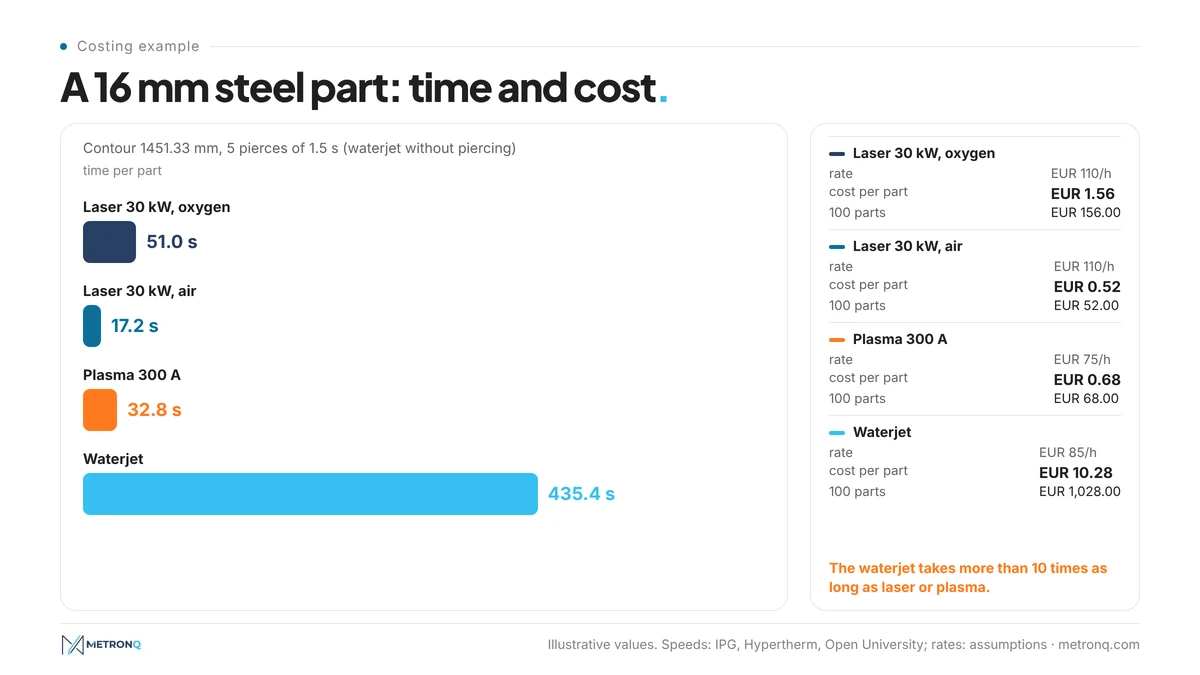
Time savings are the main argument: laser with air and plasma are close, while the waterjet takes more than ten times as long. For this part, plasma is the cheapest after the laser with air. On 3 mm sheet, Hypertherm says everything favours the laser; on very thick steel, plasma or oxyfuel. The cheapest method changes with thickness.
An ROI analysis compares machine price, hourly rate and utilisation over the service life. The best return comes from the machine that matches your parts, not the fastest one. A laser cutter pays back only at high utilisation because it costs the most.
Safety, durability, versatility and automation
Safety: according to Hypertherm, lasers need a safety enclosure, plasma and waterjet do not. Plasma produces fumes and noise, while the waterjet works without fumes and dust (Open University) but needs guarding against the high-pressure jet. Manual plasma cutting adds safety glasses, gloves and fume extraction, because there is no enclosure.
Durability depends on consumables. OMAX warrants its MAXJET 5i nozzle for 500 operating hours, and the Open University gives over 1000 hours for waterjet nozzles. In plasma, the electrode and nozzle determine service life, and Hypertherm calculates pierce times with moderately worn consumables.
The waterjet is the most versatile. Plasma cuts only conductive metals, the laser cuts metals and, with CO₂, also plastics and wood, and the waterjet cuts almost everything except tempered glass. When different materials are cut on one machine, the waterjet wins: granite, glass, aluminium and plastic without changing gas. For the least distortion of thin stainless steel, the laser with nitrogen is the closest alternative to the waterjet.
Automation started early: in 1971 Kjellberg first ran several plasma cutting machines in parallel, and in 2003 it introduced the world's first flow-controlled automatic plasma gas supply (Wikipedia). New machines of all three types have CNC control and can work with automatic loading, and 30-40 kW lasers are shifting the boundary with plasma.
Thin and thick material: which method for what
Thin material is the laser's domain, thick material that of plasma and waterjet. Hypertherm gives the laser usually up to 6 mm, plasma up to 80 mm and the waterjet up to 305 mm. Material and thickness determine the choice more than any other factor.
According to Hypertherm, the laser cuts thin metals best, combining speed and accuracy. Plasma also cuts thin sheet, twelve times faster than oxyfuel according to Hypertherm, but with a wider kerf and larger angle. Thin plastics and composites are a job for the waterjet.
Structural steel above 30 mm is usually cut with plasma or oxyfuel. Waterjets and high-power lasers can also cut it, but more slowly or at higher cost, and according to Hypertherm the laser handles rusty and painted plate only with limitations. Plate of 50 mm and more is, according to Hypertherm, the domain of plasma up to 80 mm and of oxyfuel beyond. A laser with a thick-sheet package cuts up to 60 mm (Trumpf, 24 kW).
After cutting: CNC machining
Many cut parts then go on to machining. Threads, fitted holes, chamfers and faces with tolerances that no cutting method achieves are produced on a milling machine. The wider the heat-affected zone and the more bevelled the edge, the more stock allowance the finishing operation needs.
After plasma, the allowance is larger than after laser or waterjet, and mechanical cutting by saw or waterjet leaves no heat-affected zone. Laser and waterjet cuts need the least rework, and for thick steel the laser with air. Fine profiles such as small gear teeth rarely reach milling tolerances, so machining is planned together with cutting, as described in our articles on CNC milling and tolerances vs CNC machining cost.
MetronQ does not price laser, plasma or waterjet cutting, but it does price CNC machining of the cut part: the shop sees in the shop panel a price breakdown by operation, calculated on its own machines and rates. Setup time is charged once per order, as explained in the article on the most expensive minute, and the article on machining quotes shows how times are converted into prices.
Frequently asked questions about laser, plasma and waterjet cutting
What is laser cutting and how does it work?
A focused laser beam melts the metal and a gas jet blows it out of the kerf. According to Trumpf, the kerf is under 0.5 mm and heat input is low. Most modern laser cutters use fiber lasers, which according to Wikipedia convert 20-30% of electrical energy into laser light.
What is plasma cutting and how does it work?
A constricted electric arc ionises gas into plasma, which melts and blows out electrically conductive metal. According to Hypertherm, plasma cuts plate up to 80 mm, including rusty and painted material. Its disadvantages are a 1-4 mm kerf with spatter (Trumpf) and an edge angle of 1-3° (Hypertherm).
Which cutting method is best for thick plate?
Up to about 30 mm of structural steel, high-power lasers and plasma compete; above that plasma dominates, and oxyfuel at very large thicknesses. Hypertherm gives plasma up to 80 mm and Trumpf up to 150 mm on CNC machines. The waterjet cuts up to 305 mm without heat, but very slowly.
How can you save time and money when cutting sheet metal?
The biggest saving comes from matching the method to the thickness: laser for thin sheet, plasma for thick steel, and waterjet only where no heat may enter the part. With a laser on structural steel, compressed air instead of oxygen can increase speed 4.5 times at 16 mm and 30 kW according to IPG.
How much does waterjet cutting cost by comparison?
According to Hypertherm, the waterjet has the highest running costs of the three methods, and OMAX gives USD 25-35 per hour excluding labour. Time is the main cost driver, though: in our example with 16 mm steel, the waterjet takes more than ten times as long as laser or plasma.
Sources
- 1.Hypertherm, "Choosing a cutting process" (plasma, oxyfuel, laser, waterjet compared), https://www.hypertherm.com/solutions/technology/choosing-a-cutting-process/
- 2.Hypertherm, "Plasma attributes" (tolerances, bevel, heat-affected zone, piercing, rusty and painted material), https://hypertherm.com/solutions/technology/plasma-technology/plasma-attributes
- 3.Hypertherm, XPR300 specifications and cut charts (mild steel, O2 plasma), https://www.westermans.com/downloads/xpr%20300details.pdf
- 4.TRUMPF, "Laser cutting in comparison with other technologies", https://trumpf.com/en_IN/solutions/applications/laser-cutting/technologievergleich
- 5.TRUMPF, "TruLaser 3030 fiber, 3040 fiber, 3060 fiber", technical data, https://www.trumpf.com/en_GB/products/machines-systems/2d-laser-cutting-machines/trulaser-3030-fiber-3040-fiber-3060-fiber/
- 6.Kjellberg Finsterwalde, "History", https://www.kjellberg.de/history.html
- 7.Wikipedia, "Kjellberg Finsterwalde", https://en.wikipedia.org/wiki/Kjellberg_Finsterwalde
- 8.R. Sarrafi, J. Jia, J. Zhang, M. Mendes (IPG Photonics), "Advances in cutting with ultrahigh-power fiber lasers", Laser Focus World, 20.09.2022, https://www.laserfocusworld.com/laser-processing/article/14282662/advances-in-cutting-with-ultrahigh-power-fiber-lasers
- 9.J. Harris, M. Brandt, "Cutting thick steel plate" (Nd:YAG, LoPOx), Laser Focus World, 2004, https://www.laserfocusworld.com/industrial-laser-solutions/article/14215749/cutting-thick-steel-plate
- 10.OMAX, "Waterjet FAQs", https://www.omax.com/en/omax-waterjet-faqs/
- 11.The Open University, OpenLearn: "Abrasive jet cutting", https://www.open.edu/openlearn/science-maths-technology/engineering-technology/abrasive-jet-cutting
- 12.KMT Waterjet, "Abrasive waterjet orifice size / cutting speeds at 60,000 psi", https://www.kmtwaterjet.com/KMT%20Orifice-Cutting%20Speeds%20Data.pdf
- 13.Wikipedia, "Laser cutting", https://en.wikipedia.org/wiki/Laser_cutting
- 14.ISO 9013:2017, Thermal cutting - Classification of thermal cuts - Geometrical product specification and quality tolerances, https://www.iso.org/standard/60321.html
Read next
Automatic CNC machining quotes
Priced from the 3D model or the drawing, on your machines and your rates. You just approve it. 8 free quotes to start and 1 every month, no card.
Create a free account