Laser Cutting Cost: Price per Part Explained
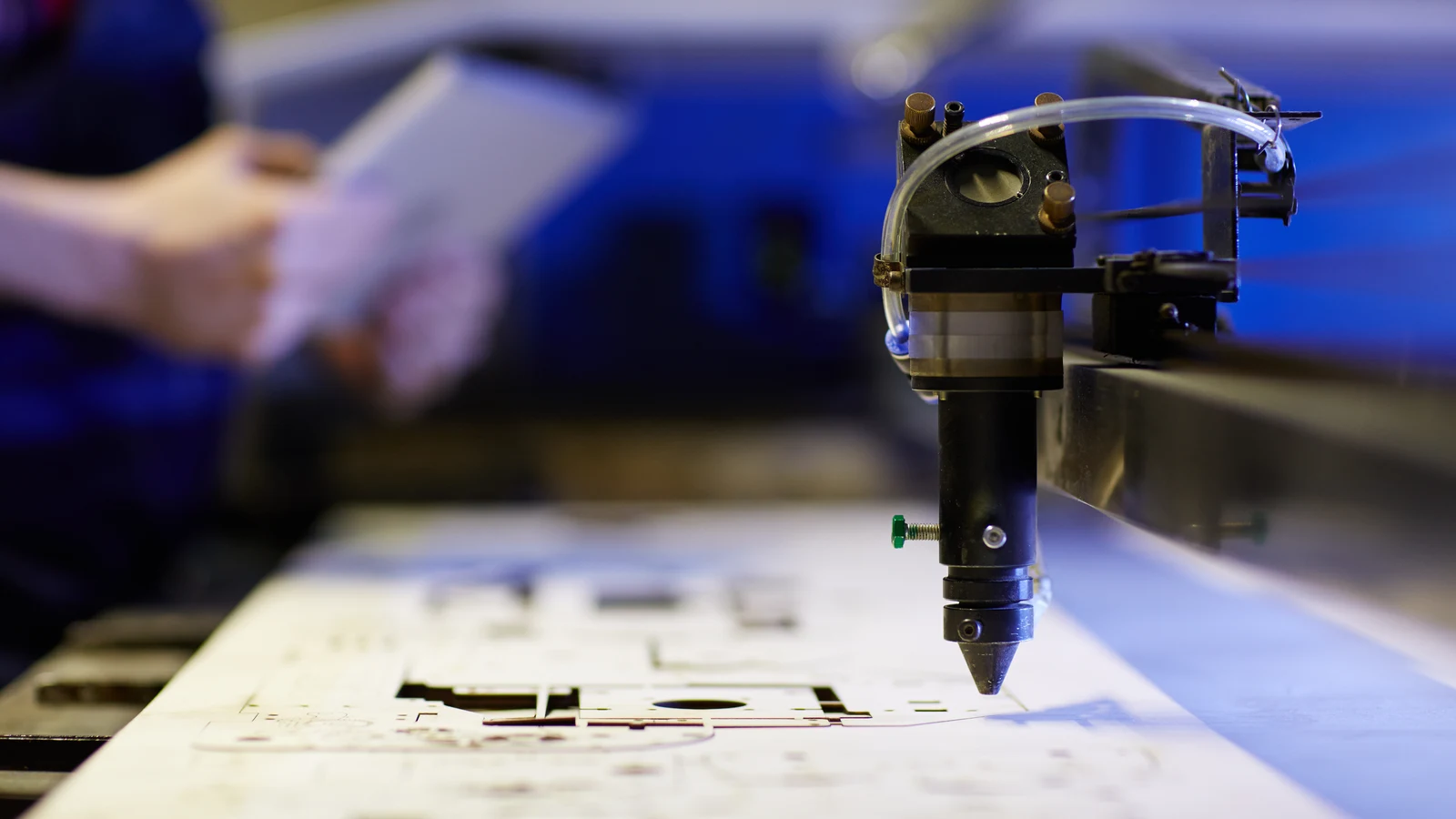
The price of a laser-cut part is made up of machine time, material, setup, programming and a markup. Its size is set by cut length, the number of pierces, material and thickness, assist gas and batch size.
What does laser cutting cost per part?
What laser cutting costs cannot be read from a single number, because the price per part comes from five items: machine time, material, setup, programming and markup. Prices per metre and per hour are only intermediate values. Anyone who takes them over unchecked prices parts with many holes and small batches too low.
Machine time and material arise with every part, setup and programming once per batch. That is why the price per piece falls with quantity, and why the quantity belongs in every calculation. The price per piece follows this formula, which also works as a simple laser cutting cost calculator in a spreadsheet:
Where:
- - price per piece [€],
- - machine cost per part [€],
- - material cost per part [€],
- - setup and programming cost per batch [€],
- - batch quantity,
- - markup for overheads, risk and margin, as a fraction (e.g. 0.2).
Machine time
The machine time of a laser-cut part has three components: cutting along the contour, piercing at the start of each contour and moving the head between contours. Anyone who counts only the cut length misses more than half the time on parts with many small holes, and with it part of the machining cost.
Where:
- - laser time per part [s],
- - cut length of all contours [mm],
- - cutting speed from the cutting table [mm/s],
- - number of pierces, one per contour,
- - time per pierce [s],
- - time for rapid moves between contours [s].
More on time norms: CNC Quoting: From Time-Norm Tables to Algorithms.
Cutting time
Cutting time is the length of all contours divided by the speed from the machine's cutting table. The speed depends on material, thickness, laser power and gas, and it drops on arcs, corners and small holes because the head has to slow down.
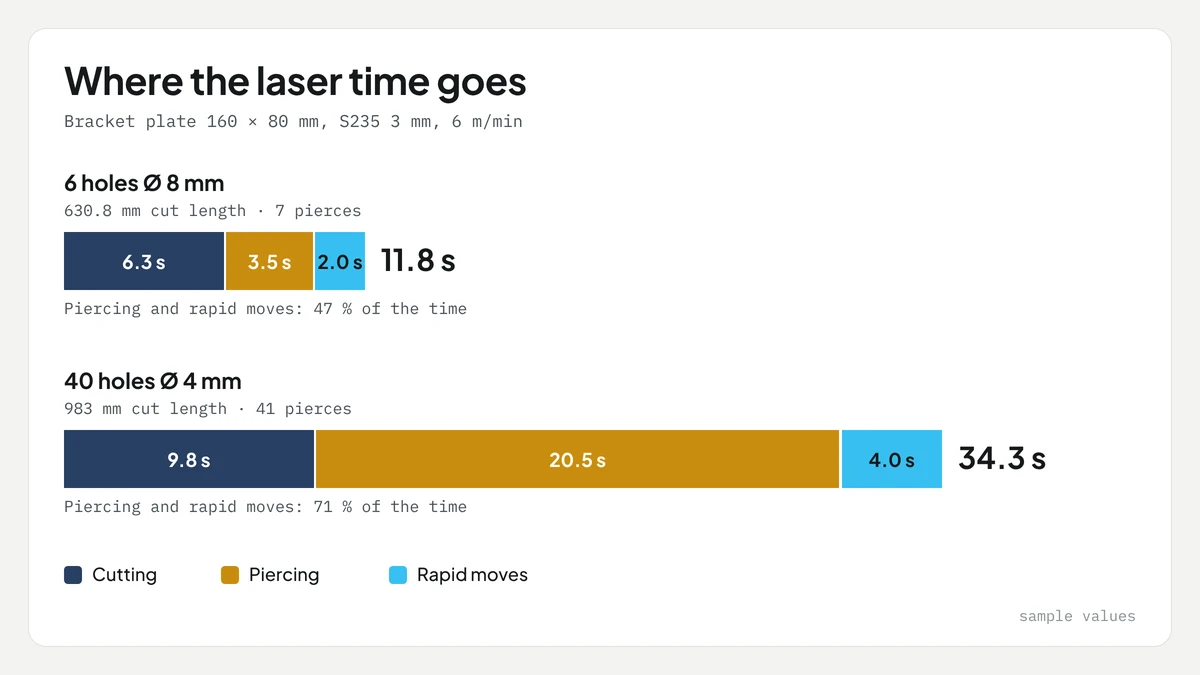
Example (sample values): a 160 × 80 mm bracket plate of 3 mm S235 has six Ø 8 mm holes. The cut length is 630.8 mm with seven pierces. Laser cutting with oxygen at 6 m/min (a sample value from the cutting table) takes 6.3 s for the cut, the pierces take 7 × 0.5 s = 3.5 s and the rapid moves 2.0 s. The laser therefore runs 11.8 s per part.
Laser cutting per hour and per metre
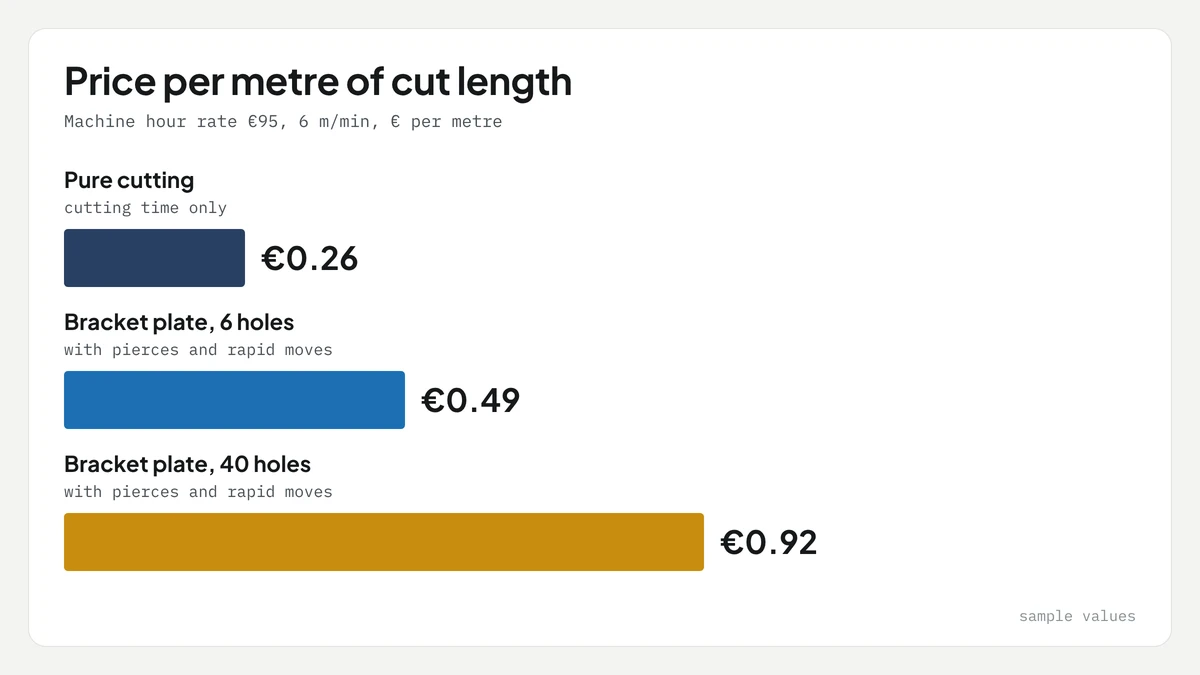
An hour of laser cutting is priced with the machine hour rate, and laser cutting per metre follows when you divide that rate by the speed. Both values are correct, but only for pure cutting time. Pierces and rapid moves are missing from them, and on parts with many holes they make up most of the time.
At €95 per hour and 6 m/min, pure cutting costs €0.26 per metre. The bracket plate from the example comes to €0.49 per metre, because pierces and rapid moves make up 47 % of the time. The same plate with 40 holes of Ø 4 mm has only 56 % more cut length (983 instead of 631 mm) but needs 34.3 instead of 11.8 s and costs €0.92 per metre. A single price per metre sets it almost half too low.
Graphic: MetronQ
Graphic: MetronQ
What does a laser cutting machine cost?
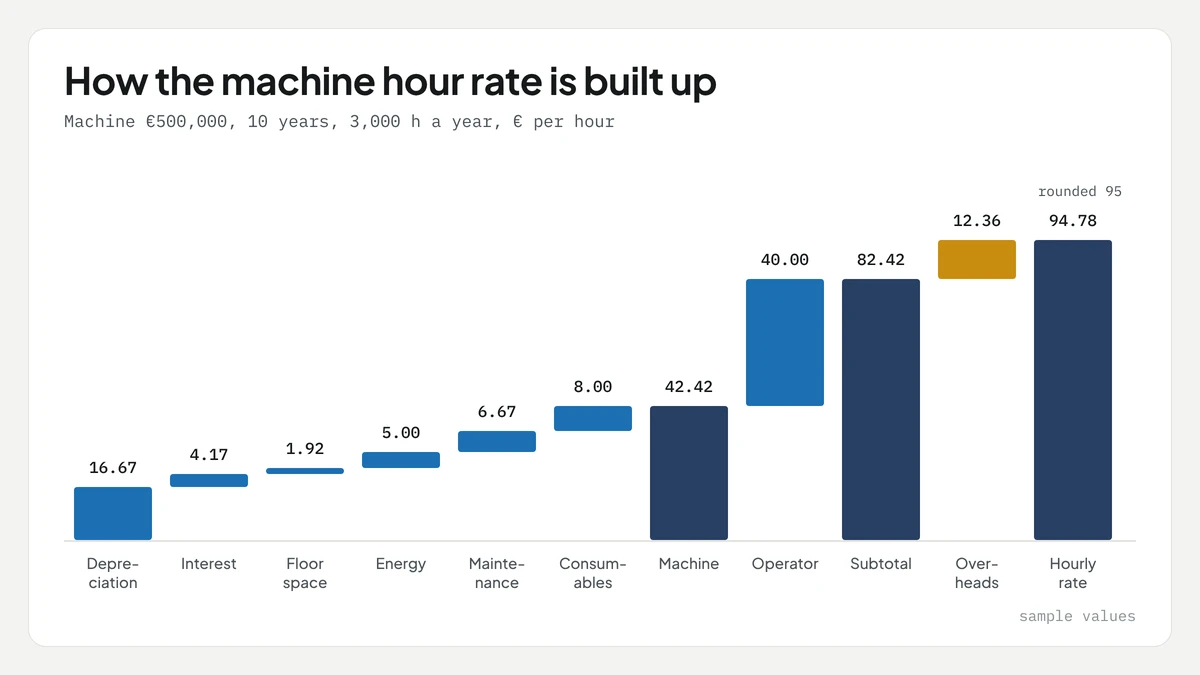
What a laser cutting machine costs depends on laser power, table size, loading automation and condition, so there is no reliable flat figure. For quoting, the machine hour rate that follows from the purchase price matters more than the price itself. It spreads depreciation, interest, floor space, energy, maintenance and consumables over the hours the machine actually runs.
Depreciation per hour follows from the replacement cost divided by the useful life and the annual running time (after Lexware, in German).
Example (sample values, not a market price): a machine worth €500,000 with a useful life of 10 years and 3,000 running hours a year gives this rate:
| Item | € per hour |
|---|---|
| Depreciation | 16.67 |
| Interest (5 % on half the purchase value) | 4.17 |
| Floor space | 1.92 |
| Energy | 5.00 |
| Maintenance | 6.67 |
| Consumables (nozzles, lenses, gas) | 8.00 |
| Machine-dependent costs | 42.42 |
| Operator | 40.00 |
| Subtotal | 82.42 |
| Overheads 15 % | 12.36 |
| Machine hour rate | 94.78, rounded to 95 |
Graphic: MetronQ
Utilisation matters more than the purchase price: at 4,000 instead of 3,000 hours a year, depreciation alone falls from €16.67 to €12.50 per hour. When a machine is only half utilised, the hourly rate rises sharply and every part gets dearer without anything changing in the cut. Listings for used machines often show only an auction or a price on request.
Sheet price: material price and sheet share
With the material price, a shop pays for the sheet, not for the part. The sheet price calculation per part must therefore include the share of the sheet a part occupies together with its spacing to the neighbour and the scrap, not just its mass. The better the sheet is used, the lower the sheet price per part.
A 3,000 × 1,500 mm sheet of 3 mm S235 weighs about 106 kg and costs €137.77 at €1.30 per kg. The part has a mass of 0.294 kg but occupies 140.3 cm² with a 5 mm gap, which is 0.330 kg. That gives €0.43 of sheet per part instead of €0.38 by part mass.
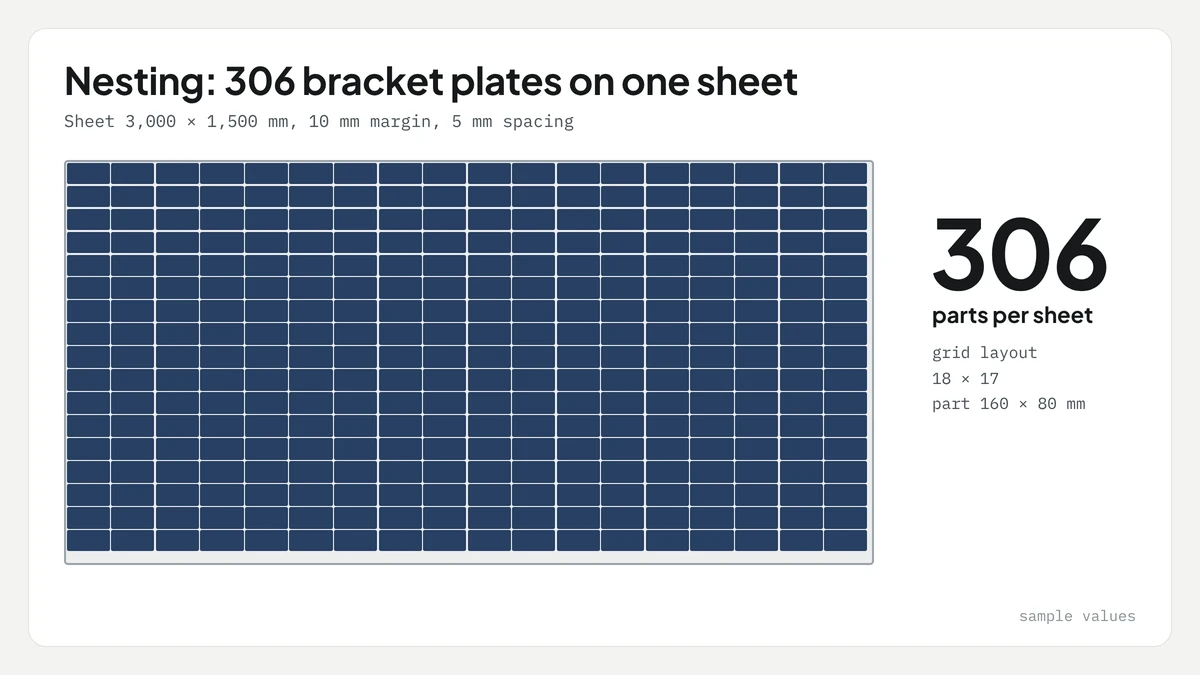
Nesting is the arrangement of parts on the sheet. The spacing between parts must be larger than the kerf, the strip of material the laser beam removes. With a 10 mm margin and 5 mm spacing, 18 × 17 = 306 bracket plates fit on the sheet in a grid layout. A nest from the CAM program usually fits more, and better nesting lowers the sheet price without extra work at the machine.
Graphic: MetronQ
Steel and stainless steel
With steel and stainless steel, grade, thickness and assist gas decide speed and material price. Structural steel such as S235 is the cheapest and fastest case and usually serves as the reference. Stainless 1.4301 (also called 304 or V2A) and 316 (V4A, 1.4401) cost more as material and are usually cut with nitrogen so the edge stays bright.
For the material price of V2A and V4A stainless, what counts is your supplier's price for exactly this grade, thickness and sheet size, including cutting to size and minimum order, not a per-kg price from a table.
Corten
Corten is a weathering structural steel, for example S355J2W to EN 10025-5. In cutting it is quoted like structural steel by thickness and gas, and only the material price differs. Enter the supplier's price for exactly this grade.
Aluminium
Aluminium and stainless steel are usually cut with nitrogen, because an oxide layer on the edge is unwanted. Aluminium has a density of 2.7 kg/dm³ and is clearly lighter than steel: the same 3,000 × 1,500 × 3 mm sheet weighs 36.5 kg instead of 106 kg. That is why the sheet price is compared, not the price per kg.
Price lists often show chequer plate, U-profiles and angle profiles in aluminium next to plain sheet. With chequer plate, clarify whether the stated thickness includes the pattern. U-profiles and angle profiles are not flatbed work: they are usually cut on tube and profile machines or on a saw.
Powder-coated aluminium sheet is a special case: the cut edge is uncoated, and heat can damage the coating at the edge. That belongs as a note in the quote, not in a later complaint.
Assist gas
The assist gas affects speed, edge appearance and cost. Oxygen reacts exothermically with structural steel and supplies extra energy, while nitrogen is inert and keeps the edges of stainless steel and aluminium bright, but it needs more pressure and more gas. Both gases belong either in the hourly rate or as a separate item in the quote.
Laser cutting with nitrogen allows speeds of up to 20 or 30 m/min on thin structural steel below 3 to 4 mm, and on thick plate the ideal pressure is 10 to 15 bar or more according to Linde, in German. Laser cutting with oxygen needs barely more than 1 bar on plate over 20 mm thick.
Anyone who promises a cut quality to ISO 9013 pays for it with speed: a better edge often means slower cutting. The standard describes dimensional tolerances, perpendicularity and roughness of thermally cut edges; the 2017 edition covers laser cuts from 0.5 to 32 mm thickness, and DIN EN ISO 9013:2025-04 is a newer version. It does not regulate the flatness of the sheet, see Flatness Tolerance.
Laser cutting wood
Cutting wood is a different process from cutting sheet metal: wood burns instead of melting, and CO2 or diode lasers are normally used for it, not the fibre lasers built for metal. A shop with a fibre laser therefore does not quote wood from its sheet-metal table.
Worked example: bracket plate from 3 mm S235
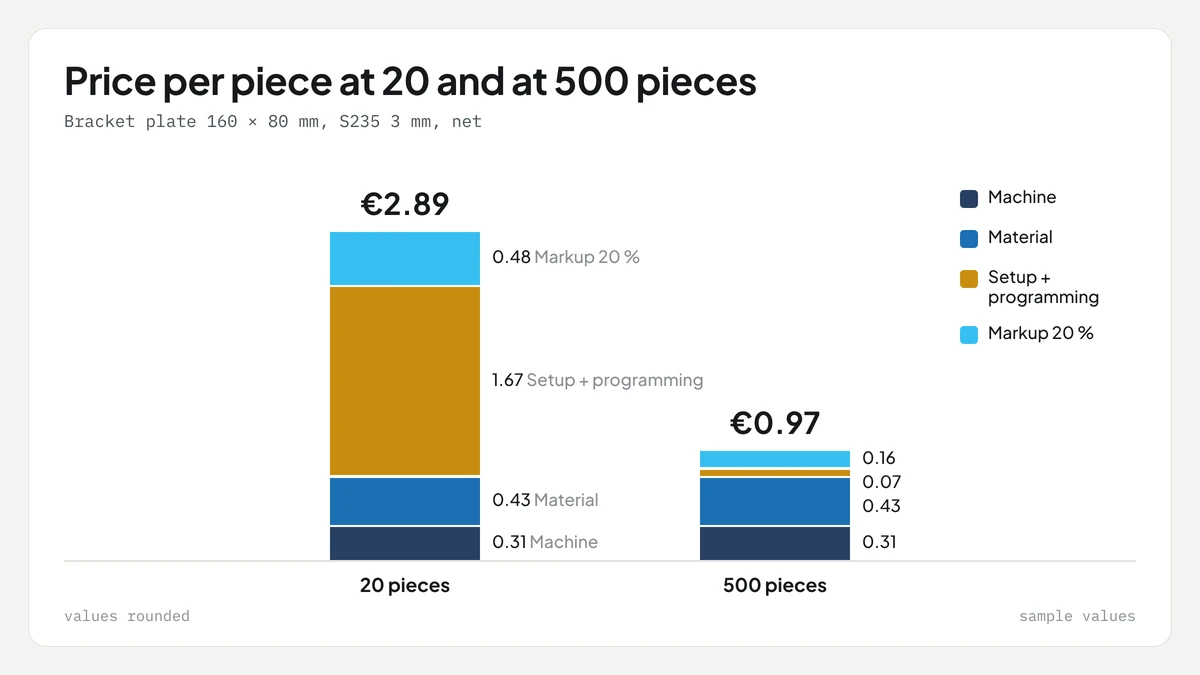
The example brings all items together: a 160 × 80 mm bracket plate of 3 mm S235 with six Ø 8 mm holes, as a batch of 20 and of 500 pieces. Sample values: €95 for an hour of laser cutting, €1.30 per kg of sheet, €70 per hour of programming and a 20 % markup.
| Item | 20 pieces | 500 pieces |
|---|---|---|
| Machine (11.8 s per part) | €6.23 | €155.80 |
| Material (0.330 kg per part) | €8.59 | €214.69 |
| Setup (10 min) | €15.83 | €15.83 |
| Programming (15 min) | €17.50 | €17.50 |
| Subtotal | €48.15 | €403.82 |
| Markup 20 % | €9.63 | €80.76 |
| Total price net | €57.78 | €484.58 |
| Price per piece | €2.89 | €0.97 |
With 20 pieces, setup and programming make up 69 % of the sum before markup, with 500 pieces only 8 %. The price per piece falls from €2.89 to €0.97 even though the machining cost per part stays the same. More on this effect in Setup Time vs CNC Part Price and How to Cut It.
Graphic: MetronQ
Laser parts online: quoting from the file
Anyone who sells laser parts online or must name prices quickly on request needs the same calculation for every file: cut length, pierces, rapid moves, sheet and batch. For standard parts it works by hand, for files with hundreds of contours it takes a lot of time, and mistakes show up only in the margin.
How it looks in a spreadsheet is shown in CNC Quoting in Excel. MetronQ calculates these items from the DXF: the shop enters lasers, cutting table, rates and sheet prices, the engine reads the contours, and the engineer approves the price or corrects it. That is how laser cutting quotes from DXF files work without every part being calculated in someone's head. For milled parts see CNC Machining Quotes and Costs Explained and How Tolerances Drive CNC Part Cost.
Frequently asked questions about laser cutting
What does laser cutting cost?
There is no fixed figure, because the price comes from machine time, material, setup, programming and markup. In the example, a bracket plate of 3 mm steel costs €2.89 per piece in a batch of 20 and €0.97 in a batch of 500. Cut length, pierces, material and batch size decide.
What does laser cutting cost per metre?
In the example, pure cutting costs €0.26 per metre at €95 an hour and 6 m/min. With pierces and rapid moves it is €0.49 per metre for the plate with six holes and €0.92 for forty small holes. A single price per metre therefore only suits parts with few contours.
What does laser cutting cost per hour?
In the example, an hour of laser cutting is the machine hour rate of €95, including the operator and 15 % overheads. The real value depends on machine value, utilisation, energy, wages and maintenance. A service provider's price also contains markup, risk and margin, so it is not the same as the machine hour rate.
What does a laser cutting machine cost?
A flat figure would mislead, because the price depends on laser power, table size, loading automation and condition. For quoting, convert the purchase price into a machine hour rate through useful life and running time, in the example €500,000 into €95 per hour.
How do you calculate cutting time?
Cutting time is the cut length divided by the speed from the cutting table. Machine time also includes the pierces, one per contour, and the rapid moves of the head between contours. For the bracket plate in the example that is 6.3 s of cutting, 3.5 s of piercing and 2.0 s of rapid moves, 11.8 s in total.
What role do steel and aluminium play in the price?
Steel, stainless steel and aluminium differ in density, material price, gas and speed. The same 3,000 × 1,500 × 3 mm sheet weighs about 106 kg in steel and 36.5 kg in aluminium. The sheet price is what gets compared, and stainless steel and aluminium are usually cut with nitrogen instead of oxygen.
Can you laser cut wood?
Yes, but with different machines than sheet metal: wood is normally cut with CO2 or diode lasers, while fibre lasers are built for metal. Rates and prices therefore differ from sheet-metal quoting, and the cutting table for metal does not fit wood.
Sources
- 1.DIN EN ISO 9013 (thermisches Schneiden, Güte der Schnittflächen)
- 2.Linde: Der Laserschneidprozess (LASERLINE)
- 3.Lexware: Maschinenstundensatz berechnen
- 4.EN 10025-5 (wetterfeste Baustähle, z. B. S355J2W)
Read next
Automatic CNC machining quotes
Priced from the 3D model or the drawing, on your machines and your rates. You just approve it. 8 free quotes to start and 1 every month, no card.
Create a free account