5-Axis Milling: 3+2, Simultaneous and Part Cost
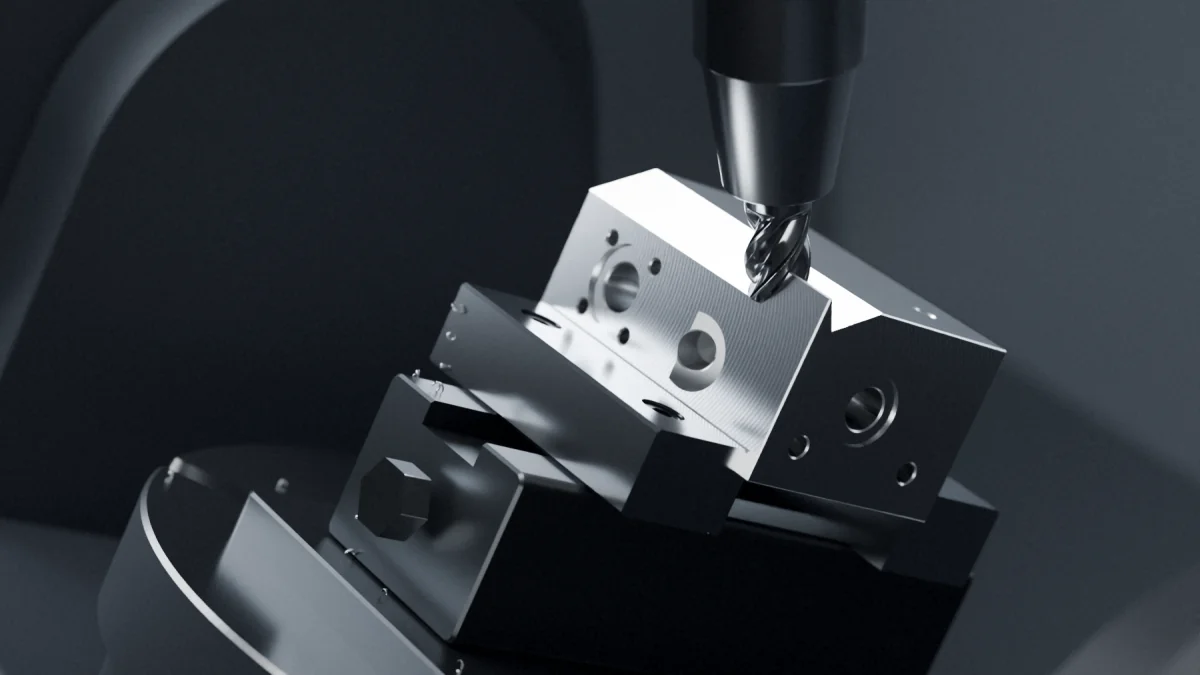
5-axis milling comes in two forms. In 3+2 machining, two rotary axes put the workpiece or the tool into a fixed orientation, and the cutting is then done with the three linear axes only. In simultaneous 5-axis machining, all five axes move at the same time. What drives the part price is mainly how many setups disappear and what a machine hour costs.
A part on a 5-axis machining centre is costed at a higher hourly rate than on a 3-axis machine. Whether that makes it more or less expensive is decided by the costing. This article compares 3-axis and 5-axis machining centres, works through an example and shows which approach pays off for which parts.
5-axis machining: 3+2 or simultaneous
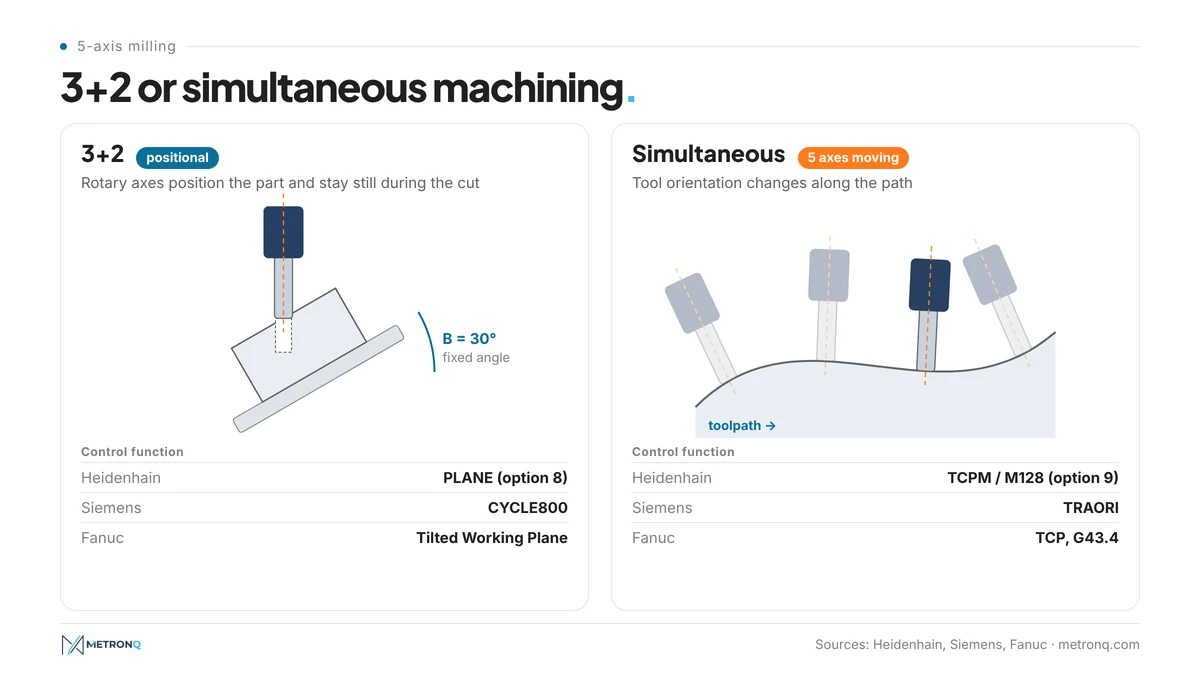
5-axis machining uses the linear axes X, Y and Z plus two rotary axes, A, B or C according to ISO 841. What matters is when the rotary axes move: with 3+2 only between cuts, with simultaneous machining during the cut. Control functions, programming and price all depend on that.
In 3+2 machining, the rotary axes put the part into a fixed orientation, and milling and drilling then work as on a 3-axis machine. Heidenhain uses the PLANE function for this, Siemens the CYCLE800 cycle and Fanuc the Tilted Working Plane function.
In simultaneous machining, the control keeps the tool tip on the path while the head or table rotates: Heidenhain with TCPM, Siemens with TRAORI, Fanuc with G43.4. In the Heidenhain TNC options, the two levels are separate: tilting with PLANE is option 8, 5-axis interpolation with TCPM is option 9. A machine can therefore handle 3+2 without being able to mill simultaneously.
Simultaneous milling is used for complex geometry such as freeform surfaces, blades and moulds. That does not make it faster: according to Autodesk training material, 3+2 often runs faster because large rotary moves over short distances are avoided.
Choosing the kinematics: which machining centre for which part
5-axis machining centres carry their rotary axes in the table, in the head, or one in each. The design determines how large and heavy the part can be and how well undercuts can be reached. Not every part fits every machine: small medical components and impellers suit a trunnion table, heavy parts are better under a swivel head.
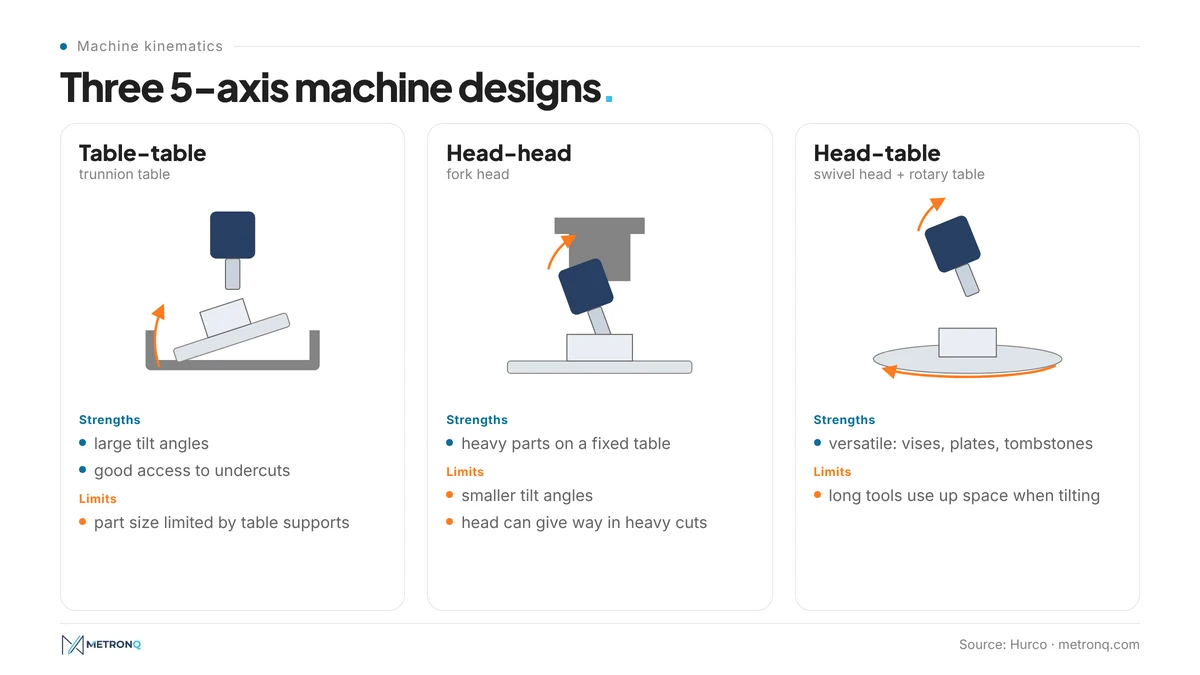
The graphic summarises the pros and cons that Hurco lists for the three designs.
CNC milling machine manufacturers advertise with phrases like latest technology, innovative machines and maximum reliability. Every builder of machining centres offers its own solutions: trunnion tables, fork heads, pallet changers and other automation. When comparing machines for costing purposes, other questions matter. Which control options are enabled? How much working space remains when tilting? Is there a touch probe with a cycle for the rotary axes?
The latest technology is not an end in itself. For very large series, a builder can make a machining centre tailored to one part family. A job shop with changing orders does better with universal CNC machines, and innovative machines also earn money only through utilisation.
5-axis production in a job shop: what drives the price
The price of a milled part consists of one-off costs per order, meaning programming and setup, and costs per piece: cutting time, re-clamping and tool wear. 5-axis machining shifts both parts. How a quote is built up is explained in the article on the machining quote.
Shorter setup time. Every setup costs setup time per order and re-clamping time per piece, and every re-clamp brings a new datum. According to Modern Machine Shop, access to five sides in a single setup enables tighter tolerances. For prismatic parts, this is usually the main advantage of five axes. What a setup minute costs is shown in the most expensive minute in CNC machining, and what tight tolerances cost in tolerances vs CNC machining cost.
Shorter tools. Tilting brings the spindle closer to the cutting area, so shorter, stiffer tools are enough. According to Mitsubishi Materials, deflection grows with the cube of the overhang: twice the overhang, eight times the deflection. Stiffer tools are less prone to chatter, which benefits surface finish and tool life. This matters especially for titanium alloys, because titanium conducts heat poorly and the heat goes into the cutting edge (Makino). With a ball nose cutter, the effective diameter at the tip is zero and, from , so is the cutting speed; when tilted, a larger diameter does the cutting.
Hourly rate and programming. A 5-axis machining centre costs more than a 3-axis machine of similar size. Control options and a touch probe come on top of the list price. The higher rate applies to every minute, including simple drilling. Simultaneous toolpaths for complex geometry also need a CAM system with 5-axis strategies, collision checking and a matching post-processor, more on this under CAM software. Programmers turn the drawing requirements into toolpaths, and with one-offs and precision prototypes these hours land on a single piece.
Which machine is free. In a job shop, the quote should be costed for the machine the part will actually run on. If a 3+2 part ends up on the simultaneous machine because no other machine is free, it pays that machine's higher rate. Automation such as pallet storage raises the rate further and only pays off when the machine keeps running unattended.
Example: hydraulic blocks with angled holes
An aluminium hydraulic block has ports on five sides and two angled holes. A 3-axis machine needs five setups, two of them in an angle fixture. On a 5-axis machine in 3+2 the block can be made in two setups: five sides in the first, the sixth in the second. All figures are example values.
| Example values | 3-axis machine | 5-axis machine, 3+2 |
|---|---|---|
| Setups | 5 | 2 |
| Setup per order | 5 · 20 = 100 min | 2 · 30 = 60 min |
| Cutting time + re-clamping per piece | 32 + 5 · 4 = 52 min | 26 + 2 · 3 = 32 min |
| Machine hour rate | 65 EUR/h | 95 EUR/h |
| CAM programming, 70 EUR/h | 1.0 h | 1.5 h |
| One-off costs per order | 178.33 EUR | 200.00 EUR |
| Cost per piece | 56.33 EUR | 50.67 EUR |
The cost per part for a batch of pieces is , with the one-off costs and the cost per piece . For a single part, the block costs 234.67 EUR on the 3-axis machine and 250.67 EUR in 3+2, and for 50 pieces 59.90 EUR and 54.67 EUR. The curves cross at (200.00 - 178.33)/(56.33 - 50.67) ≈ 3.8 pieces. The angle fixture and re-clamping errors are not included, and both speak further in favour of 3+2.
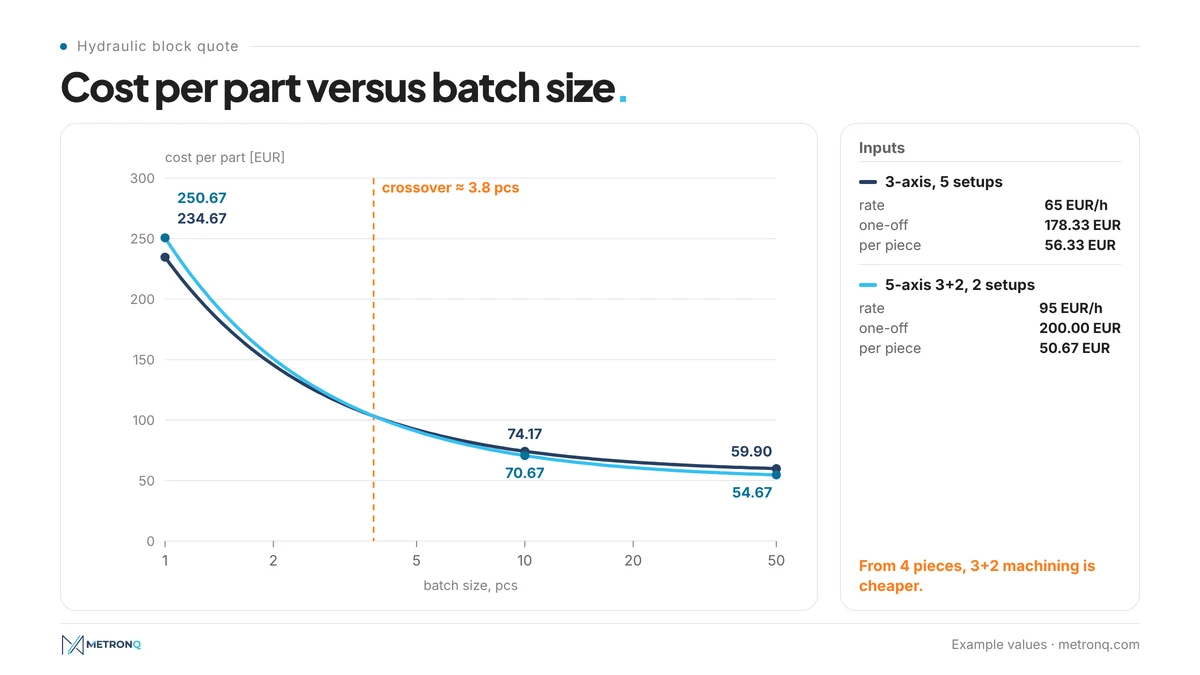
As with CNC quoting in Excel, the result depends on your own rates and times. In MetronQ, the shop enters its machine park with its own hourly rates, and the process engineer sees the price of each operation in the quote.
5-axis parts: which method fits
Prismatic parts with features on several sides are typical 3+2 parts, freeform surfaces are milled simultaneously, and rotational parts are cheaper on CNC lathes. No single technology is the best answer for every part. Which technology for which part? The overview sums up the choice, and the sections below explain the reasons.
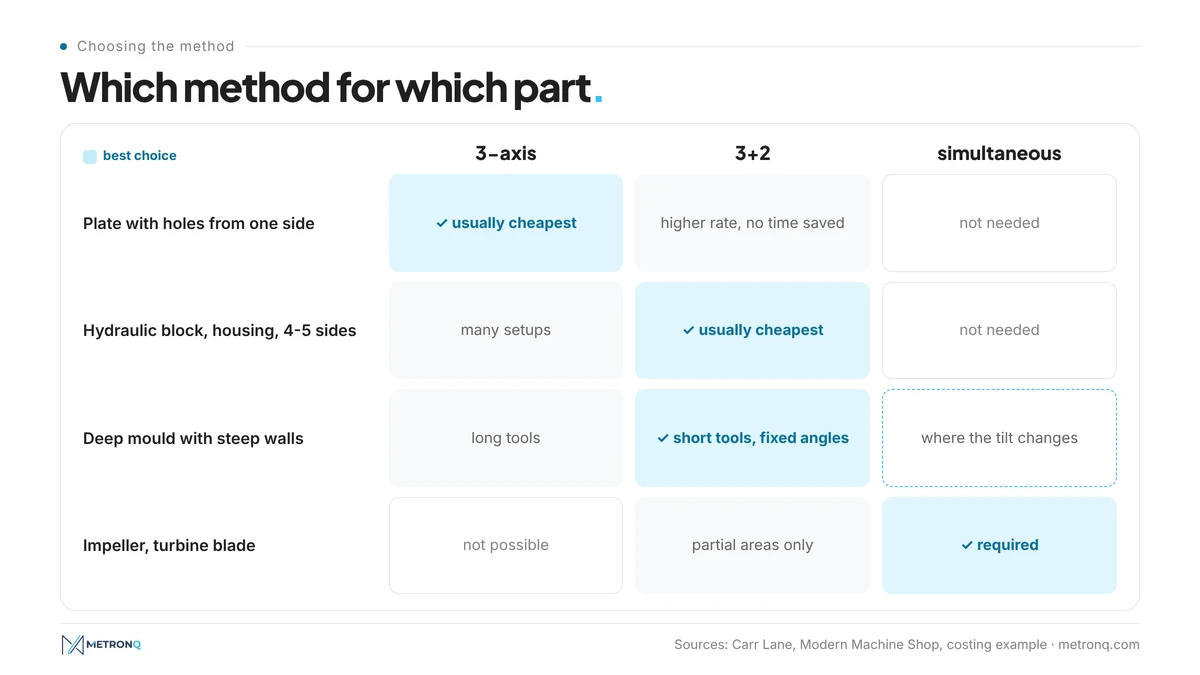
Machining complex geometry is therefore not automatically expensive. A part becomes expensive when it runs on a machine whose capabilities it does not use. Shafts and bushings are left out of the overview because they belong on CNC lathes. The basics of methods and cutting data are covered in the article on CNC milling.
Impellers and turbine blades
Impellers have twisted blades and narrow channels. The tool has to keep changing its tilt to reach the blade without touching the neighbouring one. They are therefore milled simultaneously, by flank milling or point milling, as the review by Zhou and co-authors (2024) shows. The programmer turns blade profile and collision clearance into a path with a constantly changing tool orientation.
Tool and mould making
In tool and mould making, a short tilted cutter reaches the floor of deep cavities that a 3-axis machine can only reach with a long cutter. Many areas of a mould can be finished from fixed tilt angles. Simultaneous milling is only needed where the tilt has to change along the surface.
Machine components and special machine building
Bearing blocks, flanges, aluminium housings and hydraulic blocks are typical 3+2 parts. Aluminium housings with holes on several sides gain the most, because cutting time in aluminium is short and setup and re-clamping weigh heavily. Shafts and pins, on the other hand, belong on CNC lathes, which make cross holes with driven tools in the same setup. In special machine building, programming time often decides the cost of one-off parts. A machining centre tailored to a part family, with fixed fixtures and automation, only pays off for a stable part family and is too inflexible for changing orders.
Prototypes, functional models and small batches
In prototyping, every hour of programming counts in full. Precision prototypes with features on several sides are still often cheaper on a 3+2 machine, because angle fixtures are no longer needed. Simultaneous machining only pays off for prototypes when the geometry demands it. In small batch production, the example shows that the option with fewer setups wins from just a few pieces. Titanium alloys and stainless steels are expensive, so with medical components every re-clamping error costs a lot.
Process reliability on five axes
Process reliability on five axes means that the control knows where the rotary axes really are and that the program does not collide. On Heidenhain controls, the KinematicsOpt option measures the rotary axes with a touch probe on a calibration ball. Fanuc also notes that kinematics calibration is often overlooked but clearly improves accuracy.
Anyone who needs consistently high reliability in series, for example in stainless steel or titanium, schedules such measurements as a fixed routine and simulates the program with a complete machine model before the first part. Some CNC machines also have collision monitoring in the control, which complements CAM simulation but does not replace it. A touch probe and calibration ball therefore belong in every enquiry to a machine builder, for new and used machines alike.
Frequently asked questions about 5-axis milling
What is the difference between 3+2 and simultaneous machining?
In 3+2 machining, the rotary axes tilt the part or the head into a fixed orientation and stay still during the cut, while milling is done with three linear axes. In simultaneous machining, all five axes move at the same time, and the control keeps the tool tip on the path with TCPM, TRAORI or G43.4.
When does 5-axis machining pay off?
5-axis machining pays off when a part has features on several sides or at angles, so setups can be eliminated. In the hydraulic block example, 3+2 machining was cheaper than the 3-axis machine from about four pieces. For simple parts machined from one side, the 3-axis machine remains the cheapest option thanks to its lower hourly rate.
What does an hour on a 5-axis machining centre cost?
It depends on the shop: purchase price, depreciation, control options, floor space, energy, staff and utilisation make up the machine hour rate. It is higher than for 3-axis machining centres of similar size. The example compares 95 EUR/h with 65 EUR/h, but these are example values, not market prices. For a quote, your own rate is what counts.
Is a used 5-axis machining centre worth buying?
A used machining centre can be worth it if the control, options and kinematics match the parts you make. Check whether only tilting the working plane or also simultaneous interpolation is enabled, whether there is a touch probe with a cycle for the rotary axes, and how much working space remains when tilting.
For pure 3+2 parts, it does not have to be the latest technology. The details of the options are in the documentation from the machine builder and the control manufacturer.
Which parts need simultaneous 5-axis machining?
Simultaneous 5-axis machining is needed for parts where the tool tilt has to change along the surface: impellers, turbine blades, freeform surfaces and areas of moulds with undercuts. Prismatic parts with holes and faces at fixed angles can usually be made in 3+2, which simplifies programming and simulation.
Sources
- 1.HEIDENHAIN, "Optionen und Zubehör für TNC-Steuerungen" (ID 827222): Software-Optionen 8 (PLANE), 9 (5-Achs-Interpolation, TCPM) und 48 (KinematicsOpt), https://www.heidenhain.us/wp-content/uploads/2023/05/PR_TNC_Optionen_Zubehoer_ID827222_de.pdf
- 2.Siemens, "SINUMERIK live: Multi-face milling" (CYCLE800, TRAORI), https://static.dc.siemens.com/cnc4you/tips-n-tricks/SINUMERIK-live/sinumerik+live-multi-face-milling-cnc4you-en.pdf
- 3.FANUC Europe, "Tilted Working Plane", https://fanuc.eu/eu-en/accessory/software/tilted-working-plane
- 4.FANUC America, "5-Axis Machining: Advanced Tips & Tricks" (TCP G43.4, kinematics calibration), https://www.fanucamerica.com/products/cnc/5-axis-cnc-machining/advanced-machining-tips-tricks
- 5.Hurco, "5-Axis CNC Machine Configurations: The Pros and Cons", https://www.hurco.com/resources/blog/5-axis-cnc-machine-configurations-the-pros-and-cons
- 6.Modern Machine Shop, "An Overview of 3+2 Machining", https://mmsonline.com/articles/an-overview-of-3-2-machining
- 7.Modern Machine Shop, "Machining 101: What Is Five-Axis Machining?", https://mmsonline.com/articles/machining-101-what-is-five-axis-machining
- 8.Carr Lane Manufacturing, "3+1, 3+2, and Simultaneous 5-Axis Machining", https://www.carrlane.com/engineering-resources/technical-information/machining-systems/3-1-3-2-and-simultaneous-5-axis-machining
- 9.Okuma, "3+2 vs. 5-Axis: What's the Difference?", https://www.okuma.com/blog/3-plus-2-versus-5-axis
- 10.C. Chester, Autodesk University MFG225493, "Improving the Performance of Your 5-Axis Milling Machine", class handout, https://static.au-uw2-stg.autodesk.com/Class_Handout_MFG225493_Improving_the_Performance_of_Your_5Axis_Milling_Machine_Craig_Chester.pdf
- 11.Mitsubishi Materials, Technical course: "Flute length and overhang", https://www.mmc-carbide.com/permanent/courses/70/length-of-cut.html
- 12.Makino, "Machining Titanium, Part 1: Things to Consider When Machining Titanium" (2021), https://www.makino.com/getmedia/42404176-940c-43b9-90f4-708d1d37cc73/Machining-Titanium-Part-1-Things-to-Consider-When-Machining-Titanium-(2021).pdf
- 13.Y. Zhou et al., "A review of 5-axis milling techniques for centrifugal impellers: Tool-path generation and deformation control", Journal of Manufacturing Processes (2024) 160-186, https://doi.org/10.1016/j.jmapro.2024.08.049
- 14.ISO 841:2001, Industrial automation systems and integration - Numerical control of machines - Coordinate system and motion nomenclature
Read next
Automatic CNC machining quotes
Priced from the 3D model or the drawing, on your machines and your rates. You just approve it. 8 free quotes to start and 1 every month, no card.
Create a free account